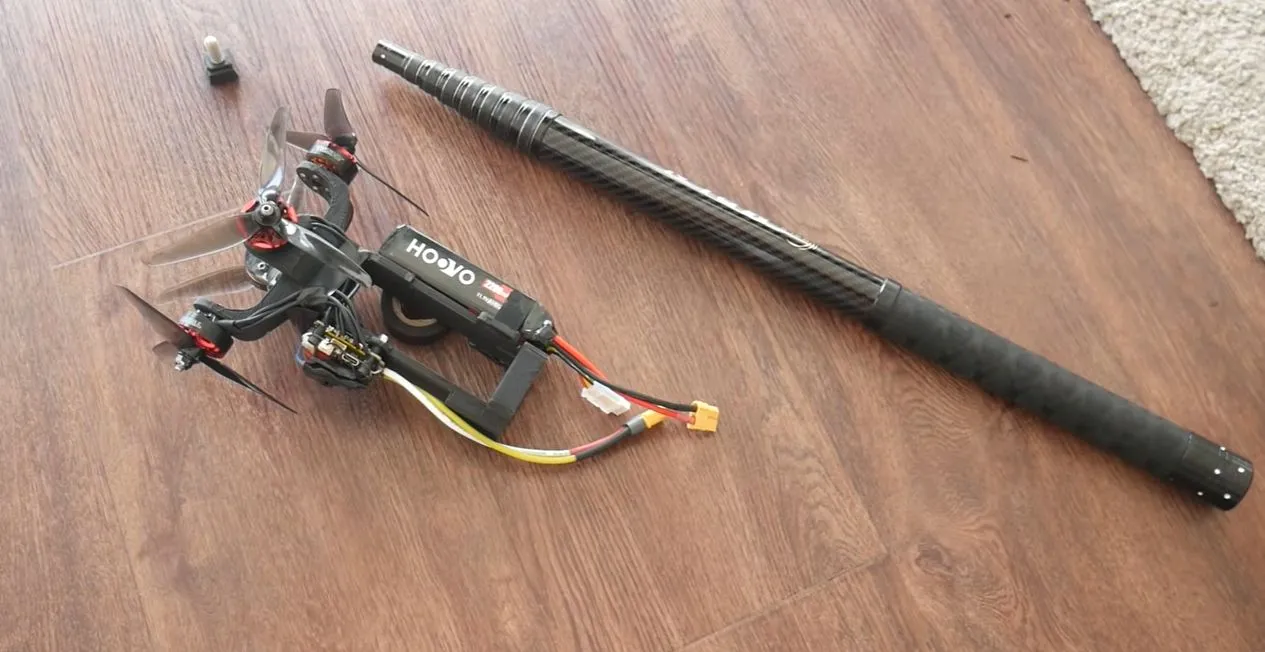
Peter Ryseck built a self-balancing pole by mounting a functional drone on top of it, not below it. The system keeps a vertical pole upright using thrust alone, with no ground contact cheating. The constraint was reaction speed: the drone had to correct for tilt faster than physics could topple the pole.
Propeller choice was the core engineering problem. 10-inch blades had too much rotational inertia to respond quickly enough. Triple 5-inch blades hit the right balance between thrust and response time. A standard quadcopter control board runs the avionics, tuned to correct without introducing new oscillations. The pole itself, salvaged from a pool fishing net, was flexible enough to act as an independent instability source.
The full video documents every failure mode in sequence: oscillation, flex-induced feedback, and wind interference. The wind solution is worth reading for alone. Rather than fighting to hold the pole at exactly 90 degrees, Ryseck found that allowing the pole to lean into the wind produces a more stable equilibrium. That single insight reframes how you think about balance control systems generally.
[READ ORIGINAL →]