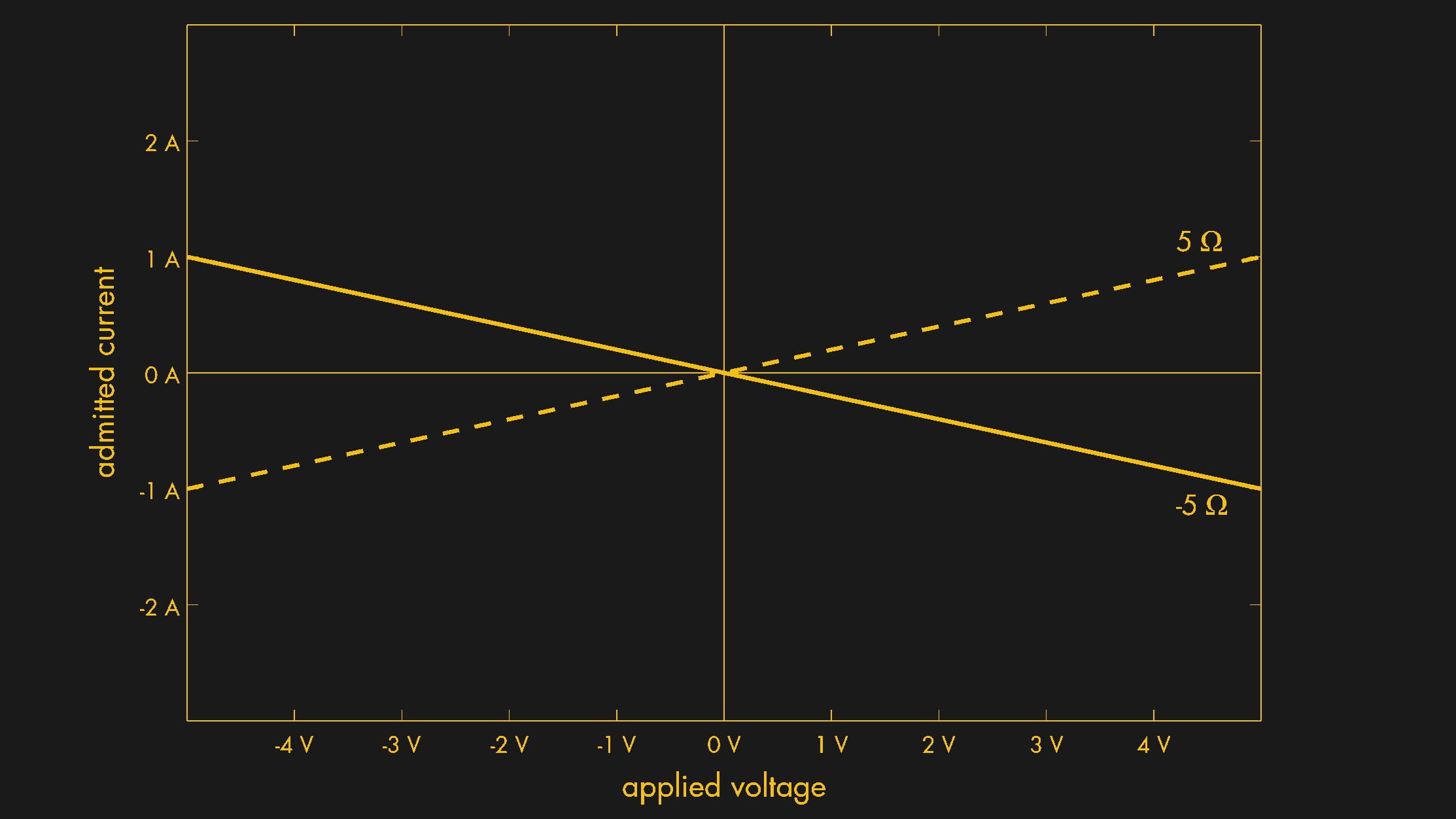
Negative resistance is not a single phenomenon. Lcamtuf's deep-dive on coredump.cx splits the concept into two distinct categories that most textbooks conflate: negative differential resistance (NDR), which is a real, passive behavior observable in neon lamps and tunnel diodes, and true negative resistance, a literal negative-ohm device that must actively source power from an external supply.
NDR is the approachable half. On a nonlinear I-V curve, certain regions slope downward: push more current through a glowing neon lamp and the voltage across it drops. No external power needed, just a device operating outside its linear range. True negative resistance, say a -100 ohm component, is a different animal entirely. It cannot be passive. Lcamtuf provides an actual op-amp circuit design that achieves ideal constant negative resistance within its operating range, with a clear warning about what happens at the boundary.
The reason to read the full piece is not the conclusion. It is the middle: the careful separation of these two ideas, the circuit schematic, and the explanation of why a power-sourcing resistor is not physically absurd, just thermodynamically constrained. Tunnel diodes are mentioned as the real-world consequence of misunderstanding which type you are dealing with.
[READ ORIGINAL →]