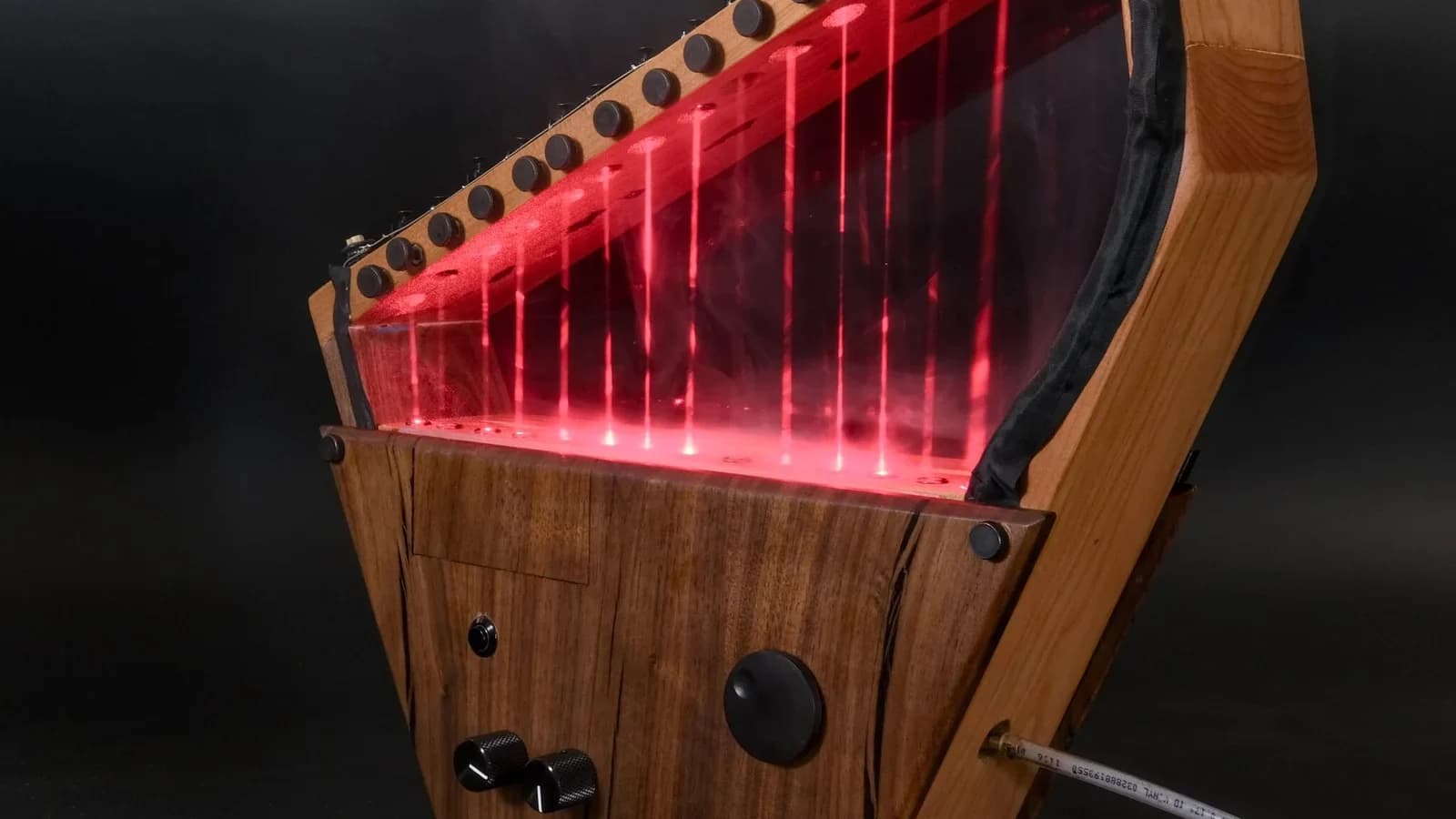
DJ Baja Blast built a desktop laser harp with more expressive controls than anything we have covered before. The instrument uses photoresistors instead of photodiodes, which lets the analog voltage drop track how fast a player occludes each beam, translating pluck speed directly to volume. On top of that: an accelerometer for tilt-based note bending, an ultrasonic distance sensor for theremin-style effects, an encoder wheel on the side, a looper pedal input, and an aux in. That is at least seven discrete control surfaces on a single instrument.
All of it feeds a Teensy 4.1 microcontroller running Karplus-Strong string synthesis, with MIDI out available for external gear. The build is housed in cherry and walnut, and yes, it has a fog machine input, which both looks good on stage and helps players locate the laser strings during practice. Full hardware files are on GitHub under the repo laserharp2.
What makes the original write-up worth reading is the design reasoning behind each sensor choice, particularly why photoresistors beat photodiodes for expressive play and how the accelerometer tilt mapping was implemented in software. The Teensy 4.1 has headroom for more synthesis modes and DJ Baja Blast says additional features are planned. Read the full build log at djbajablast.com before he adds the next layer.
[READ ORIGINAL →]