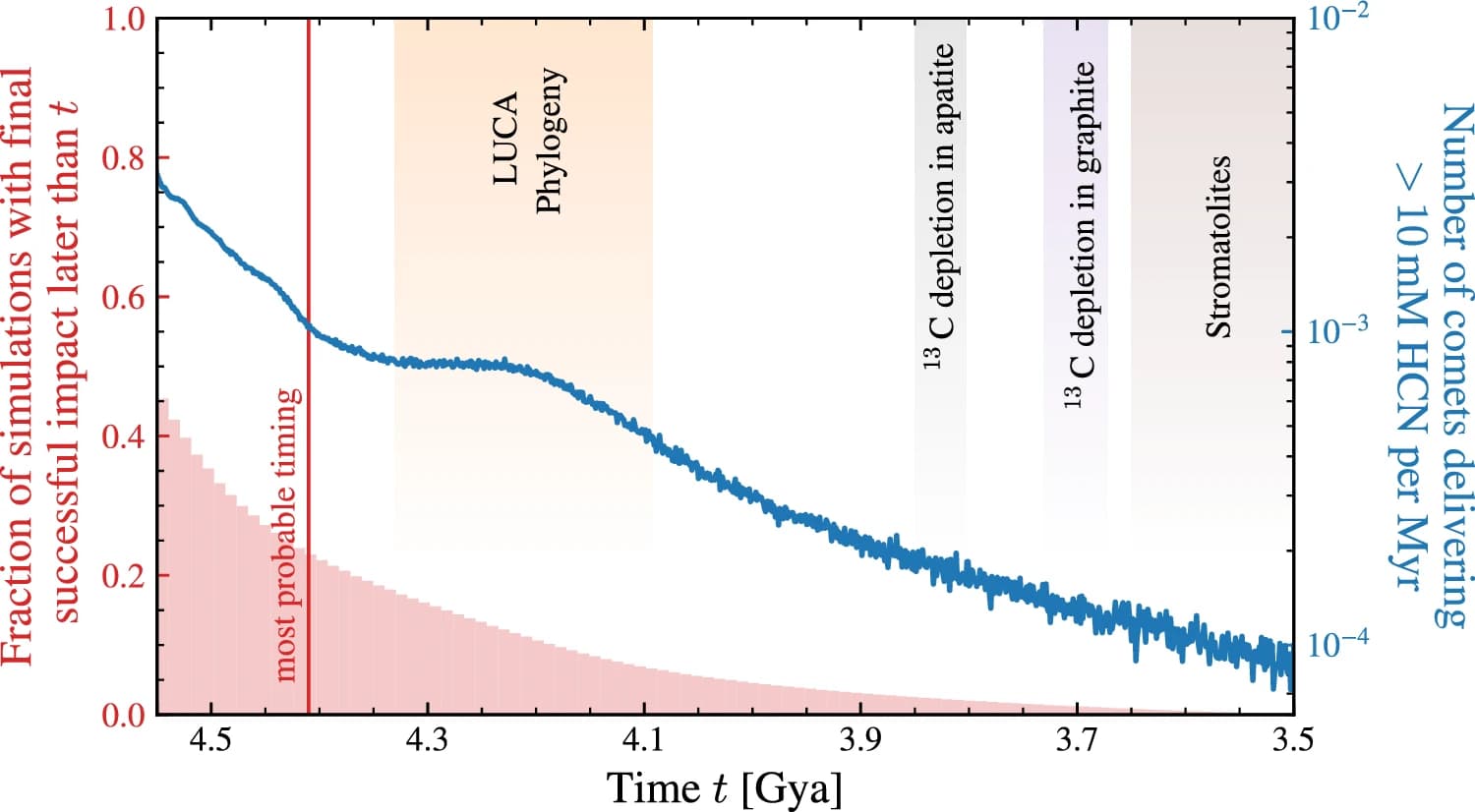
A new study in Scientific Reports by Richard J. Anslow et al. concludes that comets almost certainly did not deliver the organic building blocks for life to early Earth. Simulations of cometary impacts show that hydrogen cyanide, the key molecule tested, survives atmospheric entry and ground impact at negligible levels. Post-impact hydrolysis degrades what little remains, making any biological contribution effectively zero.
The same delivery mechanism works far better for historical Mars. The simulations show HCN surviving to the Martian surface at more than five times the rate seen for Earth, contingent on Mars retaining liquid water. That asymmetry is the most underreported finding here, and it reframes the cometary seeding hypothesis as a planetary-scale variable, not a universal one.
For Earth, the paper points toward hydrothermal vents as the credible origin site, chemical-rich environments that still sustain independent ecosystems today. The broader implication extends to ocean moons like Europa. The original paper is worth reading in full for its simulation methodology and the specific survival-rate figures across different impact scenarios.
[READ ORIGINAL →]