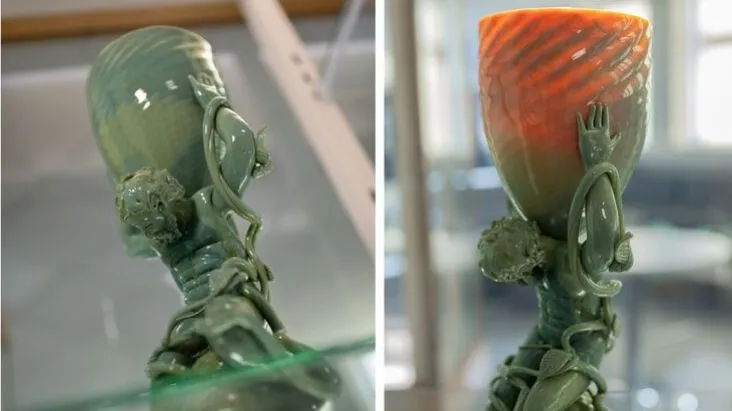
University of Sheffield researchers have replicated the dichroic effect of the Lycurgus Cup, a 3rd or 4th century CE Roman glass artifact held at the British Museum. The cup shifts from green to red depending on whether light reflects off it or passes through it. The mechanism, unknown for centuries, was identified through fragment analysis: the glass contains gold and silver nanoparticles at the nanoscale.
The Sheffield team did not simply reproduce the optical effect in flat glass. They embedded the nanoparticle formula into a sculptural Atlas figure, demonstrating the technique works in complex artistic forms. This follows prior work by Lars Kool et al., who achieved the same dichroic effect using FDM 3D-printed objects seeded with identical nanoparticles. The difference now is precision: modern fabrication lets researchers measure and dose nanoparticles exactly, rather than stumbling onto the formula by accident as Roman craftsmen almost certainly did.
The full piece is worth reading for the fabrication specifics and how the Sheffield team characterized their nanoparticle concentrations against the original cup fragment data. The deeper question it leaves open is not whether we can replicate the effect, but how Roman glassmakers achieved consistent results with it 1,600 years before electron microscopy existed.
[READ ORIGINAL →]