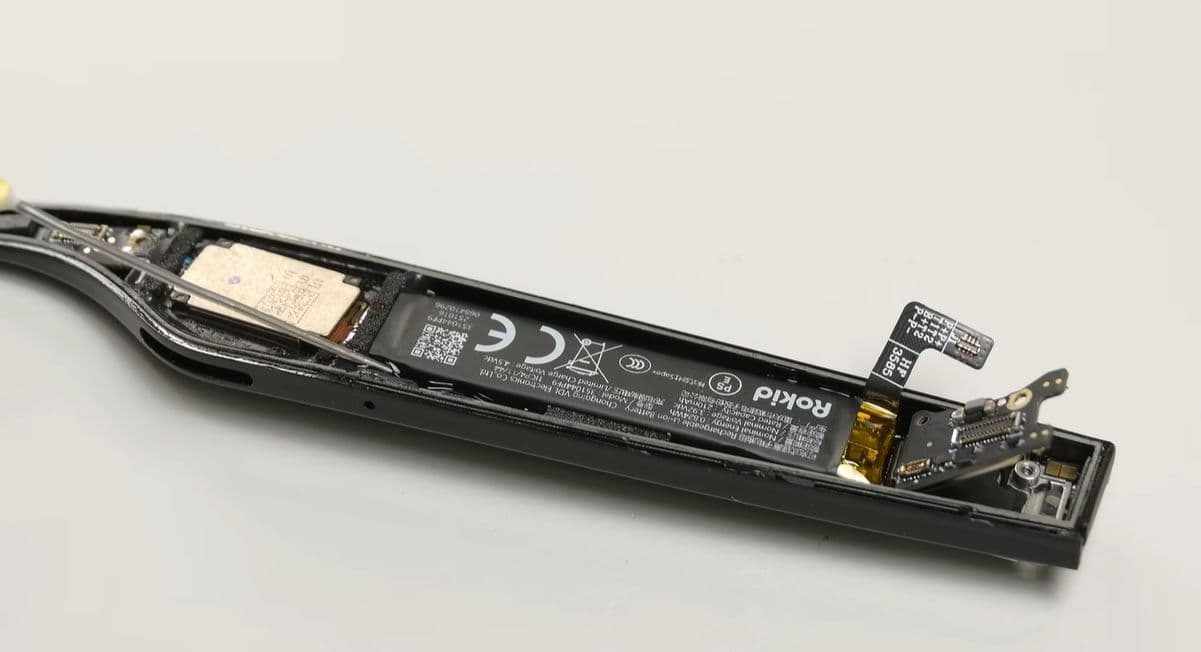
Rokid's smart glasses open with light glue and no heat gun. iFixit tore down two Chinese smart glasses, the Rokid and the Quark, both running Qualcomm Snapdragon AR1 Gen 1 SoCs with 32 GB eMMC storage and micro-LED projectors. Both also ship with an external clip-on battery alongside an internal one. The Rokid unit is the outlier: minimal adhesive, a repair-friendly internal layout, and a battery that comes out without destroying the device.
The Quark teardown tells a familiar story, requiring destructive heat and prying similar to Ray-Ban Meta glasses. The Rokid does not. That gap between two products in the same category, with near-identical specs, is the real story here. One manufacturer chose repairability. The other did not. The hardware excuse does not hold.
The EU recently exempted many wearables from its right-to-repair battery regulations. The iFixit video uses the Rokid teardown, alongside prior Pixel Watch 4 and Fairbuds teardowns, to argue that exemption has no technical basis. Read the full breakdown to see exactly where the Rokid's architecture diverges from competitors and what a repair-friendly wearable actually looks like inside.
[READ ORIGINAL →]