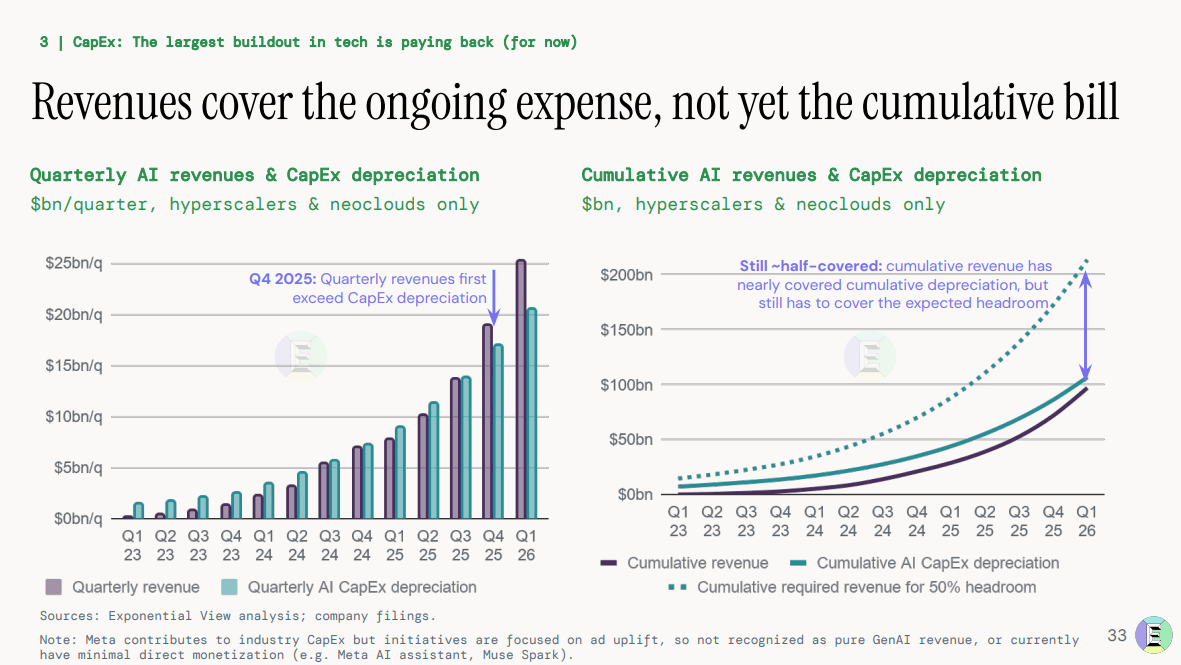
The Bank of International Settlements confirmed in its annual report what Ed Zitron has been arguing for years: the five largest hyperscalers will spend over one trillion dollars on AI-related capital expenditure from 2025 through 2026, outpacing both earnings and free cash flow, with some issuing debt to cover the gap. Oracle alone carries $129.5 billion in outstanding debt, negative free cash flow of $23.7 billion as of FY 2026, and nearly $38 billion in active lease commitments, plus $260 billion in signed-but-not-started leases. All of it is downstream of one customer: OpenAI.
The systemic risk argument is not abstract. Zitron first made it in April 2024, tracing how a single model lab failure would deliver sequential damage to NVIDIA, Microsoft, Oracle, and CoreWeave. Since then the exposure has deepened. SoftBank is selling ARM and NVIDIA stock and raising debt to fund its OpenAI commitments. CoreWeave, which Zitron called a time bomb in March 2025, remains structurally dependent on OpenAI revenue to service its own debt load. The BIS now warns explicitly that a hyperscaler spending pullback would leave supply chain borrowers unable to replace lost revenue or service their obligations.
The piece is worth reading in full not for the conclusion but for the financial archaeology: the specific debt figures, the timeline of deals, and the argument that the semiconductor supercycle was always a boot-filling exercise before a reckoning. Zitron's Hater's Guide to SoftBank publishes Friday, and his two-part Silicon Valley Bubble series is already available to premium subscribers at $70 a year.
[READ ORIGINAL →]