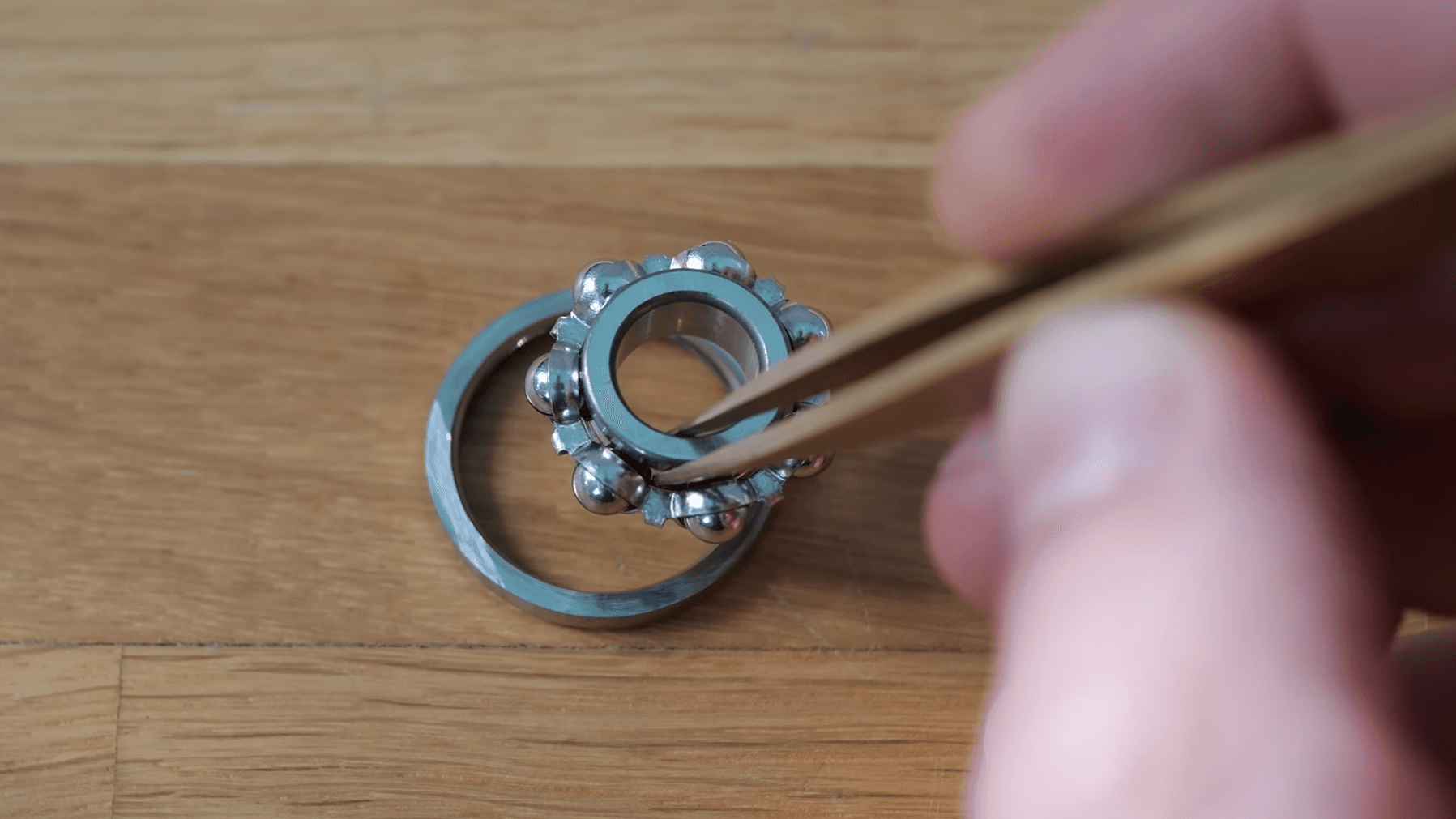
Chronova Engineering reduced milling machine feed screw backlash from 0.1-0.2 millimeters down to 30-40 microns by splitting a single ball bearing's outer race in half along its circumference, then pressing the two halves together to create an internal preload.
The build required disassembling a standard ball bearing completely, including prying apart a crimped ball cage that is normally riveted shut. Cutting the outer race at the midline and reassembling the bearing lets the two race halves compress against the balls, eliminating radial slop without the thermal expansion problems that plague two-bearing preload setups. The article is worth reading for the teardown detail alone: finding a crimped cage instead of a riveted one is not obvious, and the assembly sequence matters.
This is not a new principle. Four-point-contact bearings use the same geometry commercially, but they are obscure enough that most hobbyist machinists have never heard of them. Chronova Engineering's version proves the concept is reproducible on a bench with basic tools. The gap between 0.2mm and 40 microns is the argument.
[READ ORIGINAL →]