The agentic coding gap between closed and open models is wider than benchmarks show, and it is measured in months, not weeks. Claude Code's Opus 4.5 moment in December 2025 set a clear performance threshold for real agentic utility. Five to six months later, no open-weight model has crossed it. The author estimates 12 or more months before any open model matches this at a price point like $5/month. Google's Gemini 3.5 Flash, despite the full weight of Google's resources, is not a substitute for Claude Code or Codex in daily knowledge work. If Google cannot close this gap quickly, open-source labs from Kimi, DeepSeek, Qwen, and others certainly cannot.
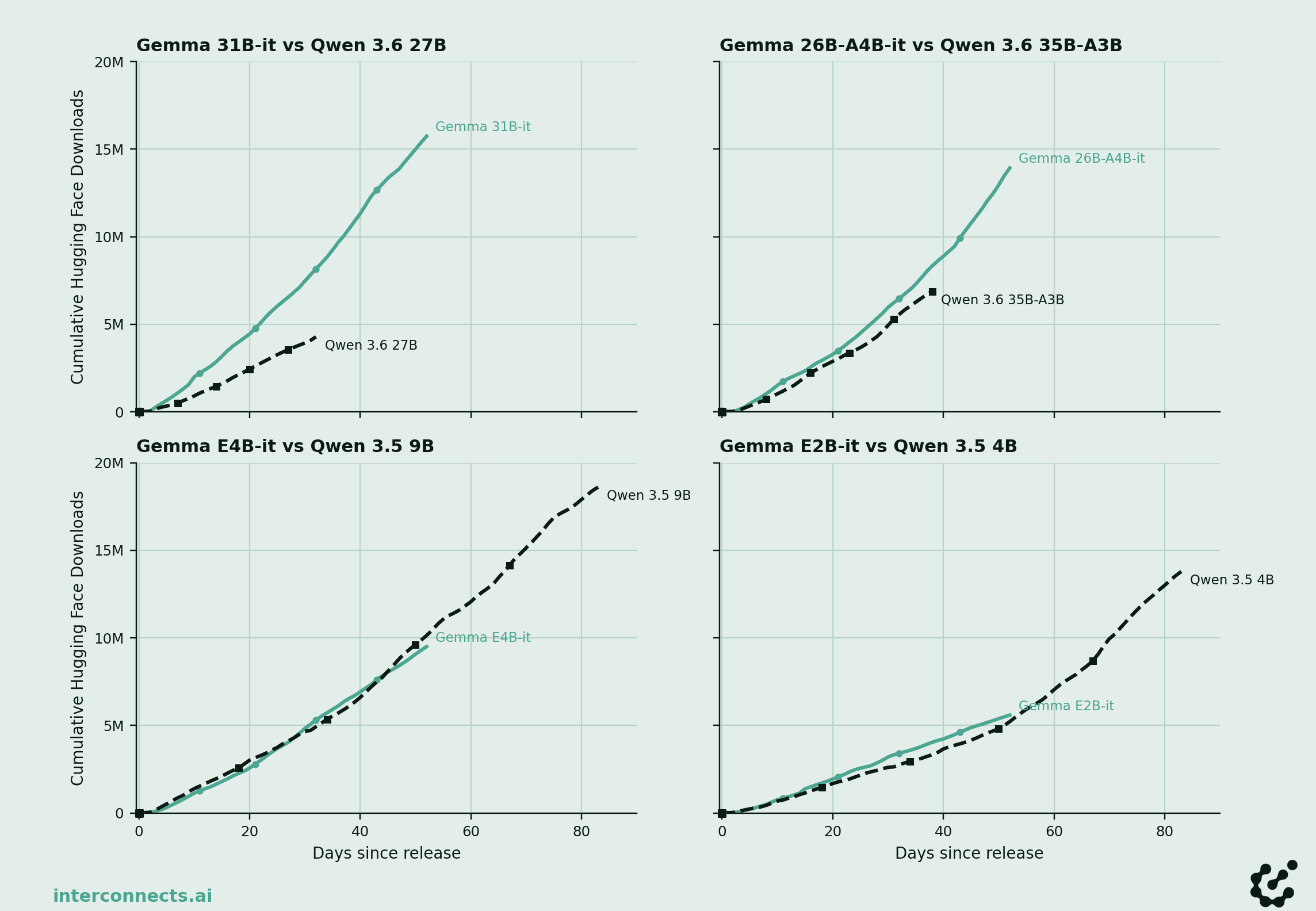
The compute disparity explains much of this. Epoch AI data shows Google controls roughly 25% of frontier lab compute, Meta and OpenAI each around 11%, Anthropic 6%. Every major Chinese lab sits far below all of these figures. The author, having spoken directly with teams at the most prominent Chinese open MoE labs, concludes they lack a near-term path to the training scale needed to produce something like Mythos, OpenAI's cybersecurity-specialized model the author calls a watershed for software engineering and security. Meanwhile, American open models are quietly gaining ground: Gemma 4 is now matching or beating equivalently sized Qwen 3.5 and 3.6 models, a meaningful shift given Qwen's multi-year dominance at those sizes.
Read the full piece for the author's argument about how agentic tools like Claude Code and Codex are becoming the primary revenue engine for frontier labs, and why that economic loop will accelerate the open-closed capability gap rather than close it. The section on open models specializing toward automated enterprise agents rather than competing in general knowledge work is where the real structural argument lives.
[READ ORIGINAL →]