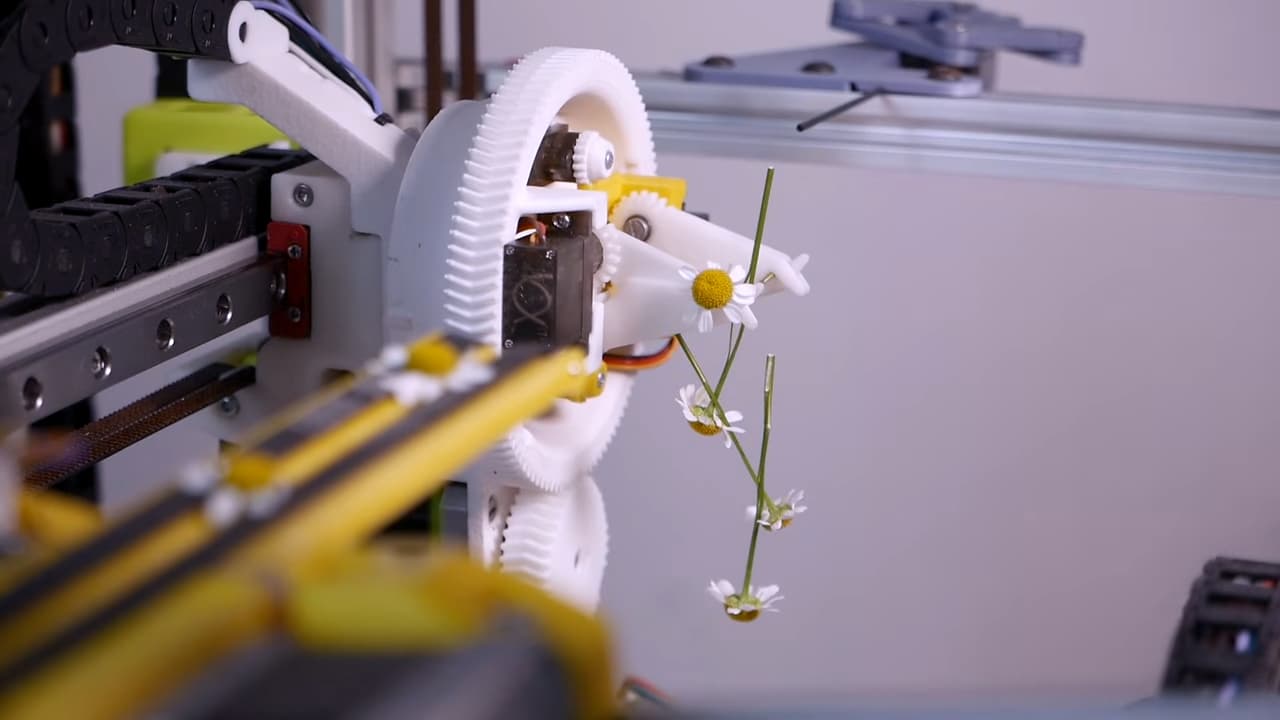
Jude Robinson built a robot called Daisy that automates the traditional craft of making daisy chains. It is a student final project, and it works without any sensors. The key design decision: daisies move to the tools, not the other way around.
The machine uses two opposing X-Y gantries with grippers, a conveyor belt for flower input, a scalpel blade, and a threading post. One gripper feeds a stem through the hole in the previous daisy, lifts it to the blade for a short incision, then the threading post passes through the new hole to receive the next flower. The two gantries alternate roles to build the chain one link at a time. Robinson identified stem shape and diameter as the primary reliability variables, and solved them with V-shaped gripper profiles that self-center stems of varying sizes, plus a blade sheath that supports stems during cutting.
The full project writeup at judeotis.me details the tuning process behind those mechanical constraints, which is where the real engineering story lives. The same sensing-free, constraint-based approach appears in industrial nut sorters and paper airplane machines. Read the original to understand how Robinson turned a flimsy, irregular biological object into a repeatable, deterministic input.
[READ ORIGINAL →]