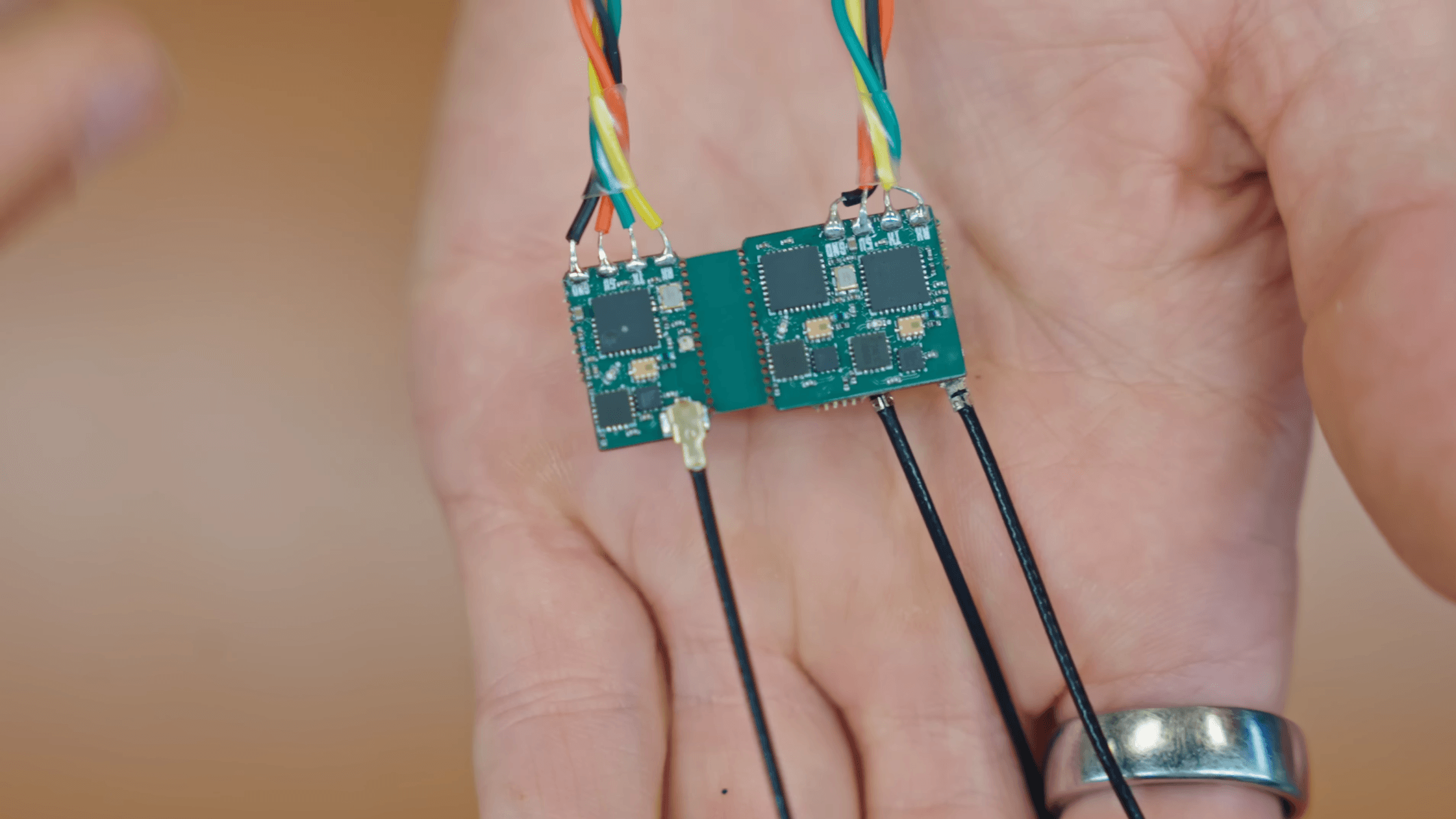
A 1-watt transmitter using ExpressLRS can control a drone over 100 kilometers away. Builder [Stan] designed four open-source ELRS receivers from scratch and documented exactly why that range is possible, publishing the hardware on GitHub under the project name OpenRX.
The key is Chirp Spread Spectrum modulation. Where Wi-Fi uses phase and amplitude modulation and most RC protocols use frequency modulation, CSS encodes each bit as a linearly rising tone, with data stored in the chirp's starting frequency. The receiver decodes it by multiplying against an inverse chirp and running a fast Fourier transform. That process yields a 24 dB processing gain, enough to pull valid signals out from below the noise floor. The hardware to do this is minimal: an ESP32, an SX1281 radio chip, and a handful of peripherals. Two of the four boards added 900 MHz antennas alongside the primary 2.4 GHz band. One board broke RF convention by using a via for the antenna connection, which should cause an impedance mismatch, but sufficient nearby ground-plane vias kept the return path intact and performance barely degraded.
In field testing, all four receivers held a link at over 5 kilometers through forest cover. The original article is worth reading for the CSS decoding explanation alone, and the linked video walks through the signal math in detail. The hardware files are open and available now.
[READ ORIGINAL →]