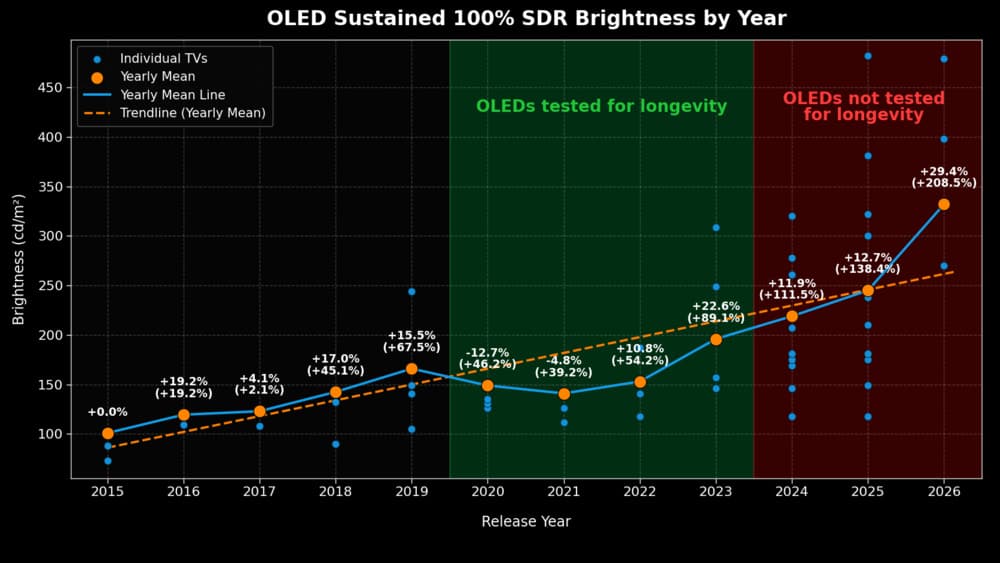
RTings tested OLED TVs spanning 2017 to 2023 across more than 10,000 hours, simulating roughly 10 years of regular use at maximum SDR brightness. The verdict: brightness has improved substantially, enough to finally support HDR content, but burn-in resistance has not meaningfully advanced. Static UI elements like the CNN news banner burned into even the newest panels with every available burn-in prevention feature enabled.
The practical implication is counterintuitive. Higher peak brightness budgets give users a lever to pull: run the display dimmer than maximum, and the organic compounds degrade slower, effectively extending panel life beyond what the rated lifespan suggests. Pixel refresh cycles are not optional. Hardware Unboxed demonstrated this on a QD-OLED monitor where a worst-case 6,000-hour stress test produced severe, visible burn-in from uneven subpixel wear.
The full RTings writeup is worth reading for the panel-by-panel degradation charts and the methodology behind the stress test parameters. The gap between marketing claims and measured longevity is the real story here, and the data shows the industry has prioritized luminance gains over solving the fundamental organic material wear problem.
[READ ORIGINAL →]