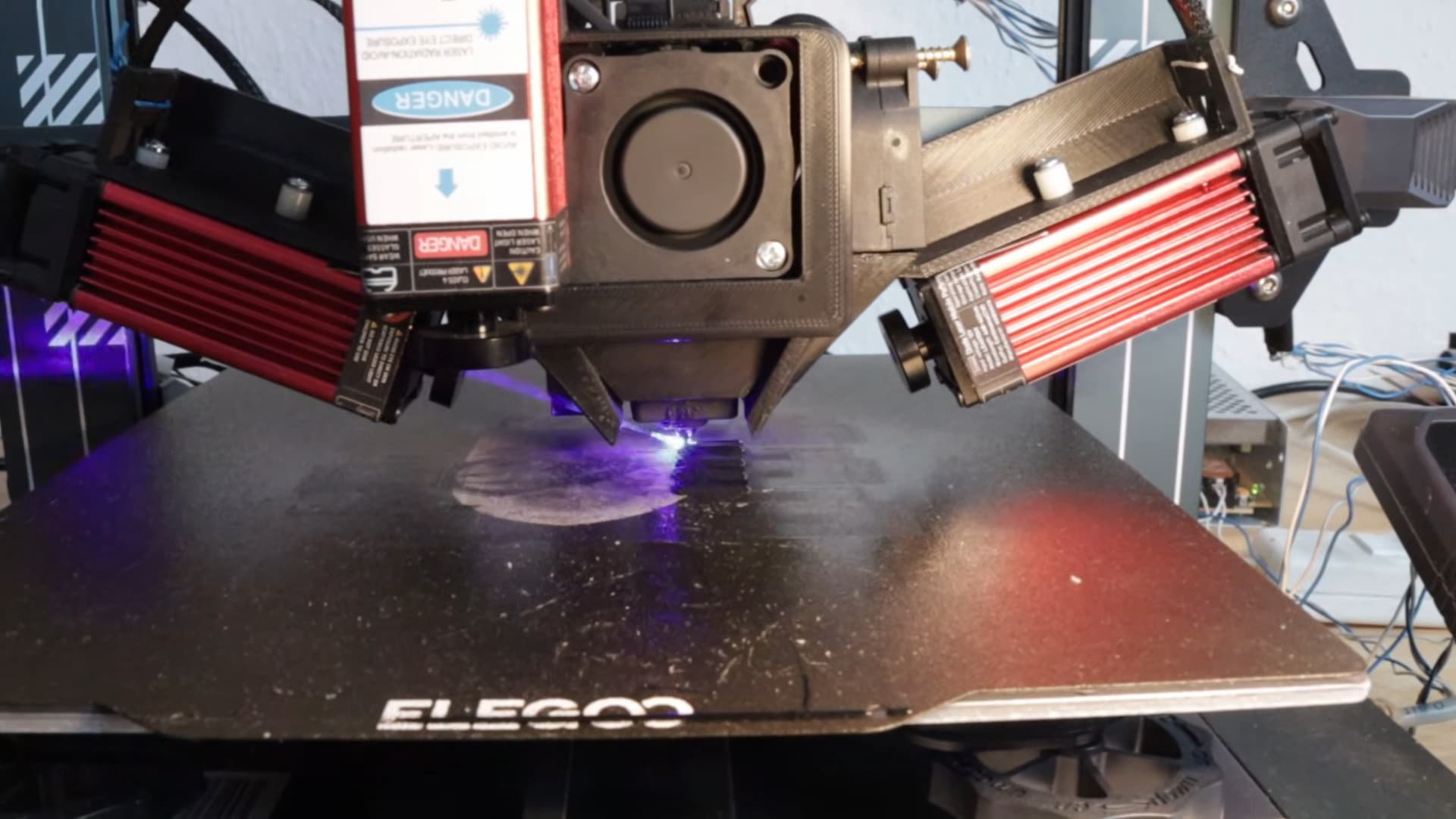
A maker known as 'I Changed a Thing' mounted two lasers onto his 3D printer's toolhead to pre-melt the previously deposited layer just before the nozzle lays new material. The result: z-axis breaking strain for ABS reaches 94% of x-axis strength, up from 60% without lasers. PLA hits 77.9%, up from 41%. These are not marketing claims. They are measured results.
The mechanism is straightforward. Molten plastic bonding to molten plastic forms a stronger joint than molten plastic bonding to a cold layer. The dual lasers also extend the hotspot dwell time, reinforcing the bond further. The video covers full print parameters and additional test datasets, which are worth reviewing before dismissing this as a one-off result.
The tradeoff is mass. The laser assembly adds weight to the toolhead, which will hurt acceleration on coreXY machines tuned for speed. That is the open engineering problem this piece does not resolve. If added mass is a dealbreaker, a layer pattern rotation strategy offers a no-hardware strength improvement documented in a January 2026 Hackaday piece. But if near-isotropic FDM parts matter to your work, this build demands a closer look.
[READ ORIGINAL →]