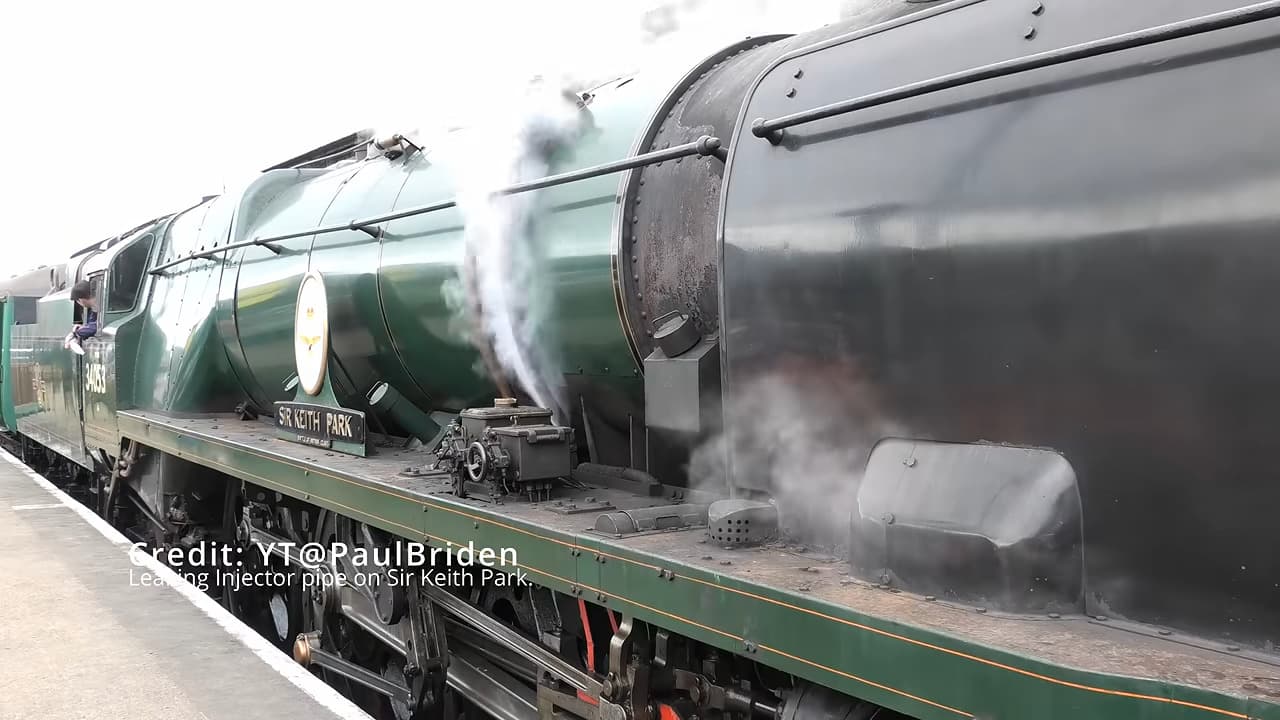
Henri Giffard solved a brutal engineering problem in the 1850s: how to push water from an unpressurized tender into a steam boiler running at 180-plus PSI, using no moving parts. His answer was the steam injector, and it still works the same way today.
The mechanism chains two fluid physics tricks back to back. First, boiler steam passes through a converging-diverging nozzle, accelerating and dropping in pressure via the Venturi effect. That low-pressure steam then hits incoming feed water and condenses into it, collapsing in volume by roughly two orders of magnitude and pulling a vacuum that drags more water in. The water is now moving fast. A second converging nozzle converts that velocity into pressure, enough to overcome the boiler's own pressure and force the check valve open. Marc Flint's video is worth watching precisely because the chain of causation is non-obvious: the condensation step is the part that breaks intuition, and he earns his explanation there.
Beyond historical curiosity, the injector is more efficient than a mechanical pump because the condensed steam returns its heat energy to the feedwater before it enters the boiler. Less coal burned, less water wasted. The original article links to related Hackaday projects on 90-year-old boiler restorations and modern steam locomotive builds, giving this real applied context.
[READ ORIGINAL →]