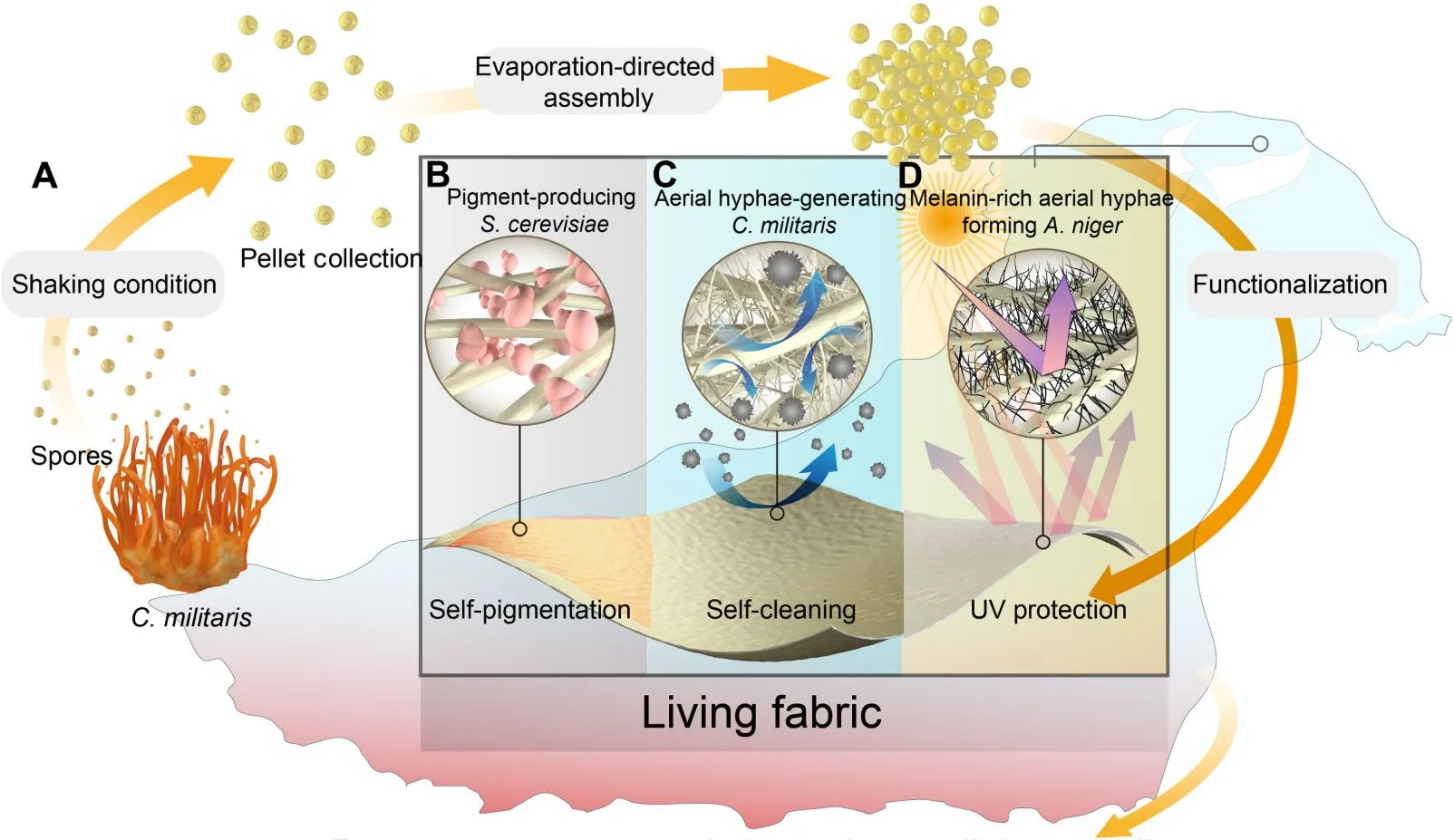
Researchers have grown functional fabric from living fungi. Ke Li et al., publishing in Science Advances, built a textile platform using Cordyceps militaris mycelium sandwiched between films, then seeded with pigment-producing Saccharomyces cerevisiae and melanized Aspergillus niger for UV blocking. The result is an engineered living material, or ELM, that is biologically active after construction.
The functional payoff is real: self-healing capacity, environmental responsiveness, tunable coloration, and UV radiation blocking, all without synthetic dyes or post-processing chemistry. The platform approach matters more than any single result here. The researchers built a generalizable system, not a one-off sample, which means different microbial cultures can be swapped in to target different properties.
The paper is explicit about what remains untested: washability, abrasion resistance, breathability, and wearer comfort. None of those benchmarks exist yet. Read the full paper to understand the layering architecture, the co-culture methodology, and exactly how far the platform has been validated, because the gap between current results and a wearable garment is precisely where the interesting engineering problems live.
[READ ORIGINAL →]