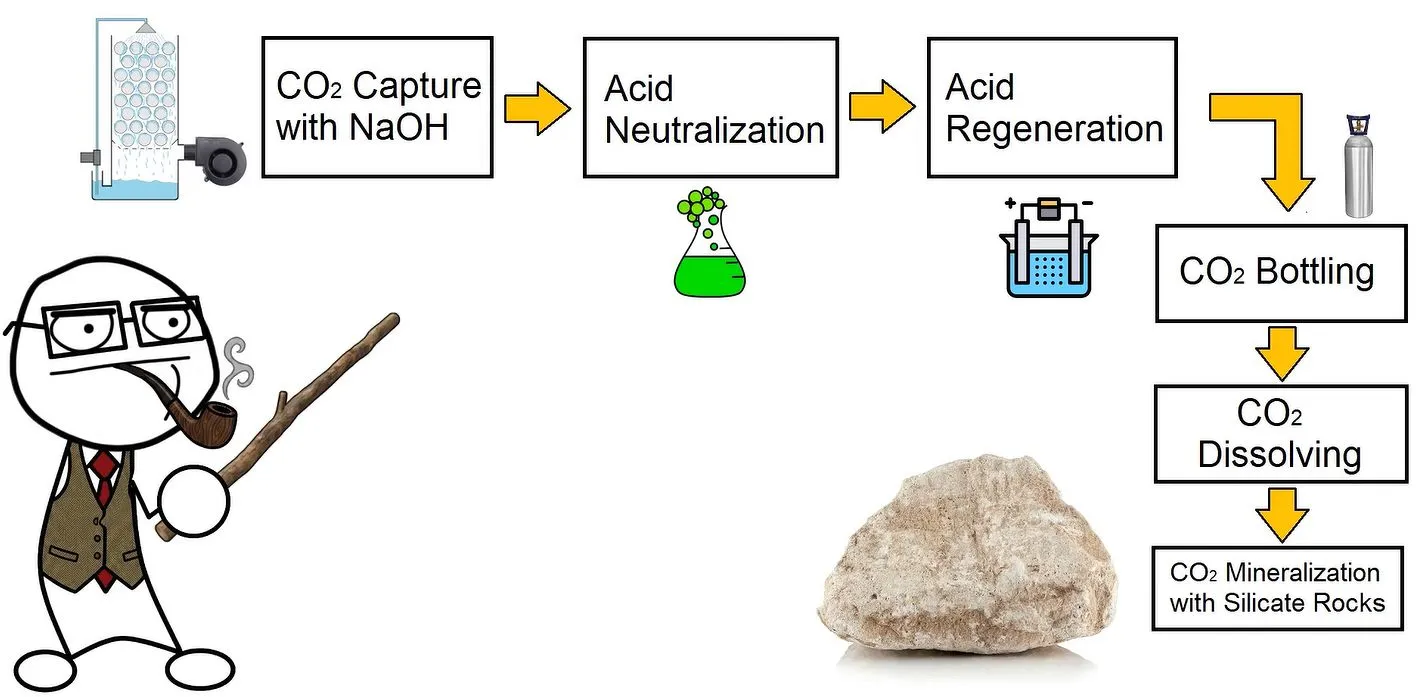
A garage experimenter called Hyperspace Pirate captured and permanently mineralized 4.3 grams of atmospheric CO2, roughly 2 liters, using a sodium hydroxide capture loop, sulfuric acid release step, and crushed wollastonite as the final mineralization substrate. The process runs at high pressure and temperature to force the reaction, and the sulfuric acid is regenerated in-loop using a cation exchange membrane electrolysis cell built by Rowow.
The chemistry here is what makes this worth reading in full. This build skips the common calcium-based capture routes and instead converts CO2 through sodium carbonate and sodium bicarbonate before stripping it back out with acid for the mineralization step. Each stage has specific failure modes, regeneration costs, and energy inputs that the original video works through quantitatively.
The scaling math kills the dream. The video's own calculations confirm that direct air capture at this scale makes no economic sense given atmospheric CO2 sits at only 400 ppm. Point-source carbon capture at industrial emitters is more viable but still borderline. The build matters anyway: it is a reproducible, documented baseline for a full mineralization pipeline outside a lab, and that is rarer than it should be.
[READ ORIGINAL →]