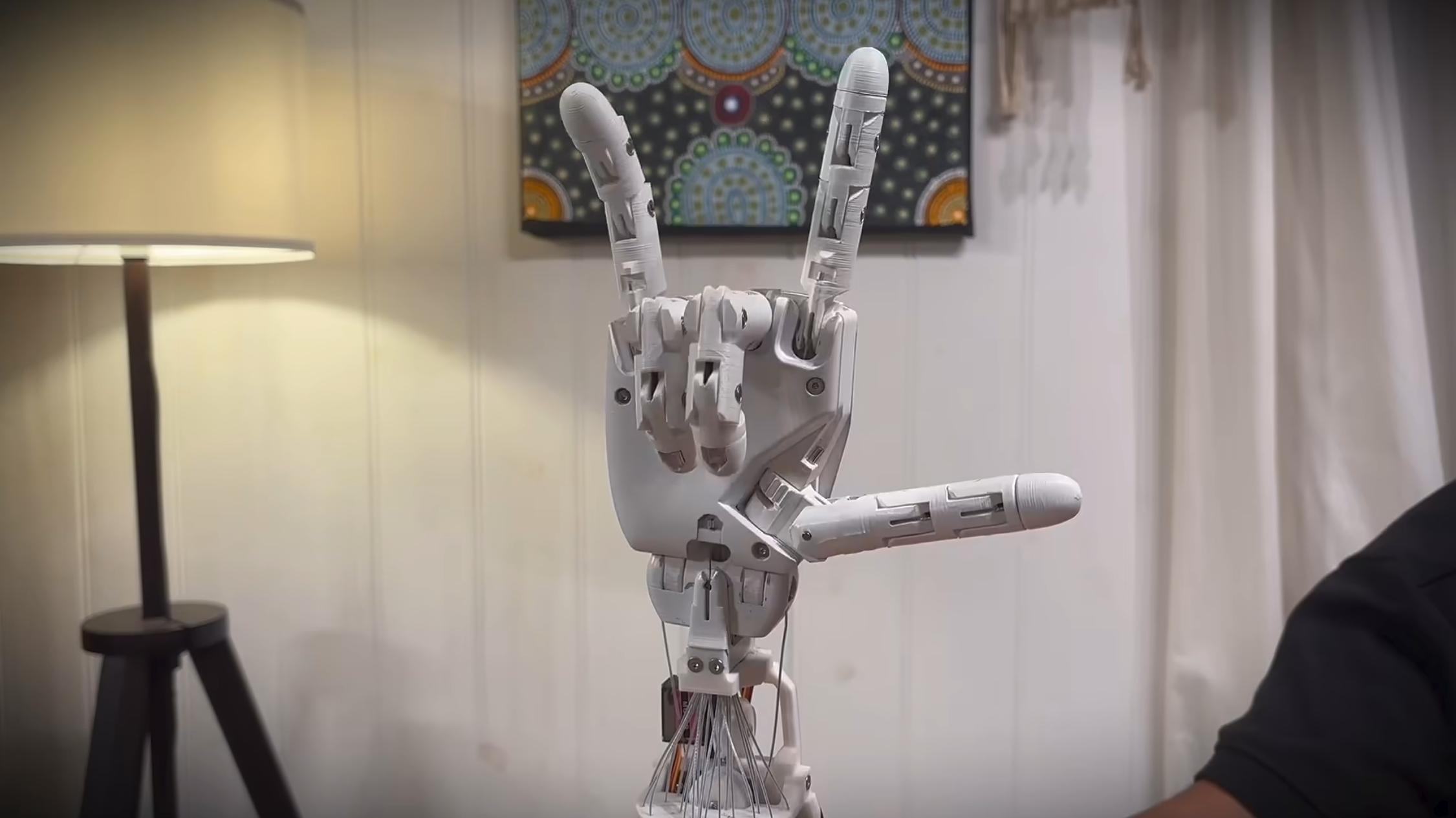
A builder named Mahdi has constructed an 18-degree-of-freedom robotic hand for under $300 in parts, targeting one of robotics' hardest unsolved problems: dexterous manipulation. The skeleton is 3D-printed, servo-driven, and modeled as a full forearm, with motors housed in the forearm section and tendons running to the finger joints, directly mirroring human anatomy.
Two specific engineering choices make this design worth studying in detail. First, Mahdi uses thin steel rope instead of synthetic fiber cable, eliminating the need for small knots by allowing tendons to be tensioned and crimped. Each tendon runs through a PTFE tube for friction reduction and routes through the center of rotation at every joint, keeping tendon path length constant through the full range of motion. Second, continuous rotation at the wrist base created a power delivery problem: small slip rings couldn't handle servo current draw, and large ones were too expensive. The solution is a coiled flat ribbon cable with a printed guide that winds and unwinds with rotation, cheaper and more compact than any slip ring.
The full build video is on YouTube. What the article does not resolve is how the hand performs under load, what control system drives it, and whether the steel tendon crimping holds under repeated stress cycles. Those gaps are exactly why the source is worth reading.
[READ ORIGINAL →]