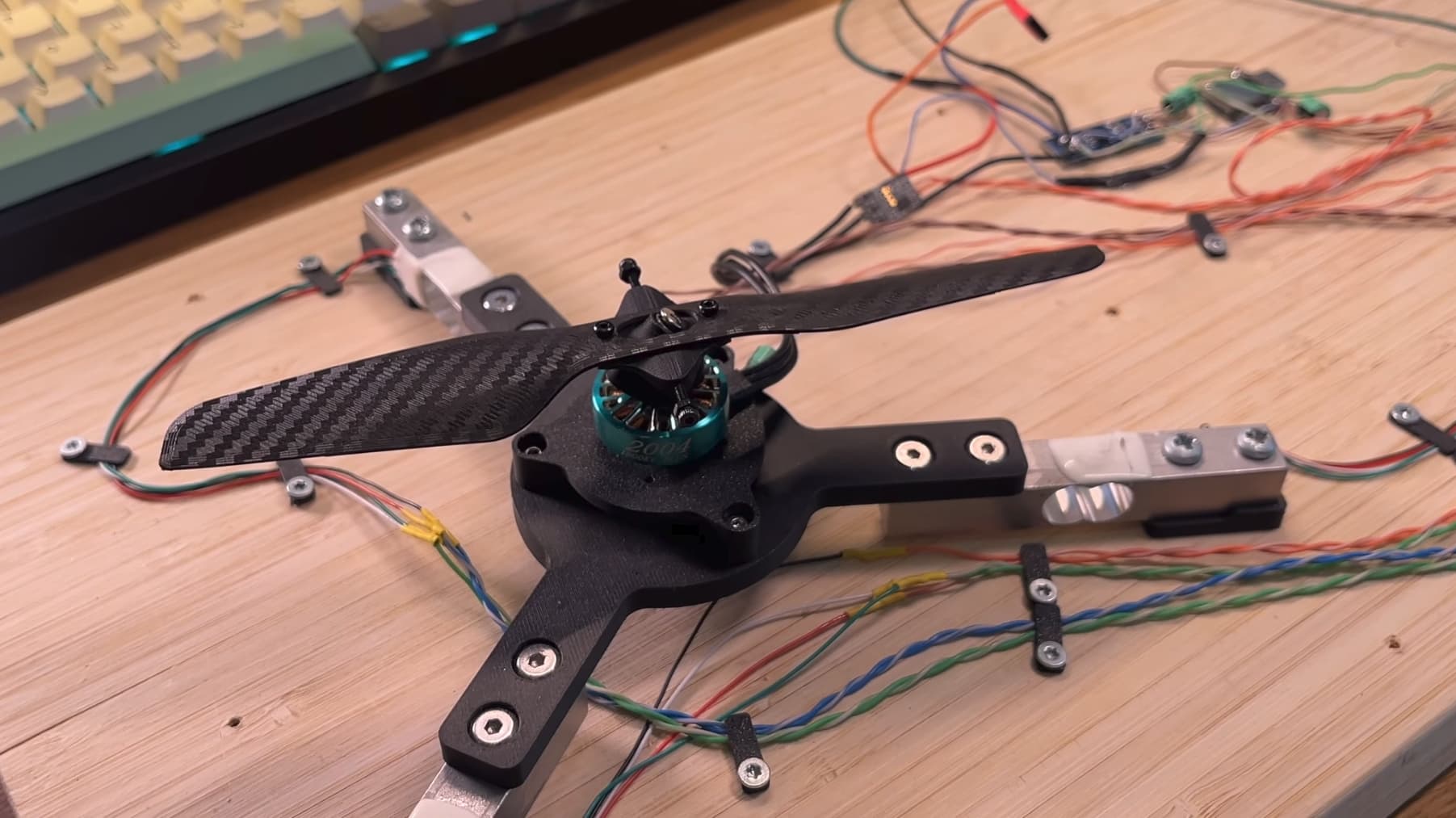
A hobbyist going by 'worked in theory' eliminated the swashplate entirely from a scratch-built RC helicopter rotor by using under-actuated angled hinges, where varying motor speed throughout each rotation causes blade inertia to shift pitch without any control linkages.
Two linkage-free approaches were tested first. The Black Hornet-style design, used in real nano drones, failed due to friction overpowering blade response at speed. A second low-friction swashplate variant still demanded actuators and added weight. The angled-hinge approach won: one hinge per rotor outperformed a shared two-rotor hinge on friction sensitivity, linearity, and response. Blades were 3D-printed as flat blanks and thermoformed over printed molds. Added tip weights, required to restore blade neutral angle under constant rotation, produced a useful side effect: passive vibration damping.
The full build is unfinished, but the rotor design is functional and documented on video. This is the second under-actuated propeller project Hackaday has covered recently, both tracing lineage to Tom Stanton's virtual swashplate work from 2020. Read the original for the specific hinge geometry and the friction failure data that killed the Black Hornet approach.
[READ ORIGINAL →]