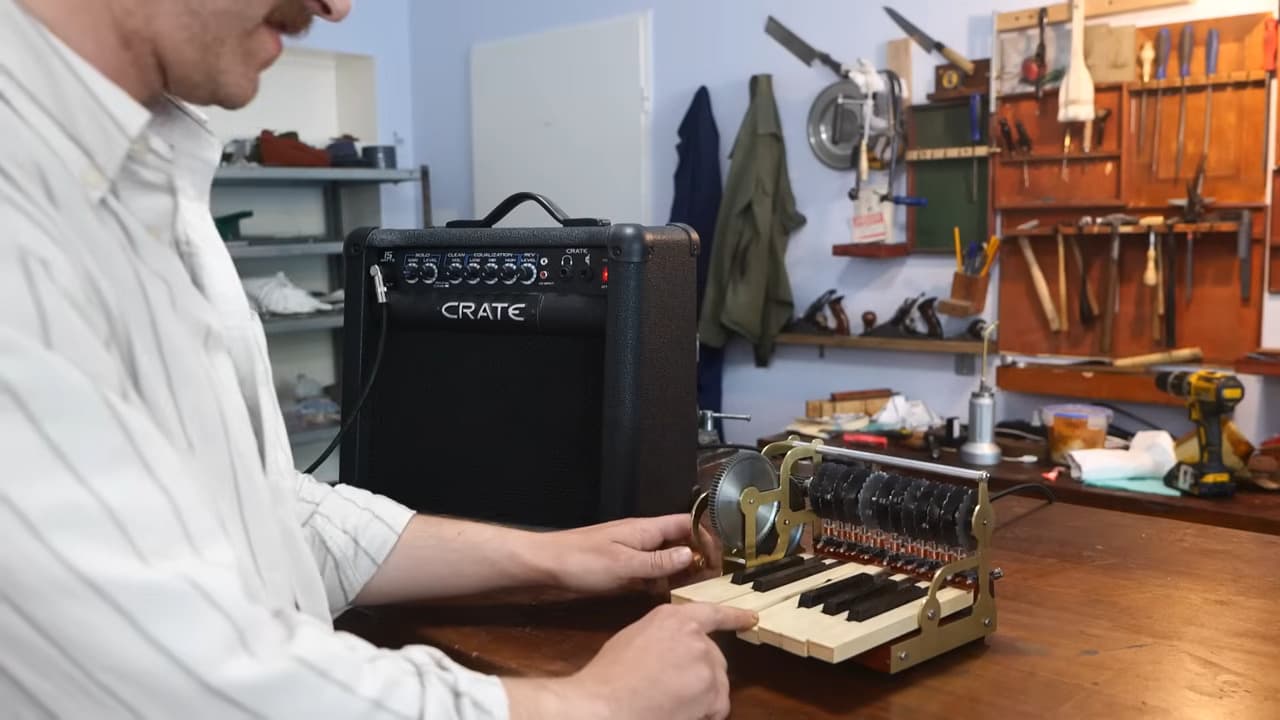
Uri Tuchman built a single-octave, hand-cranked Hammond organ from brass and wood to demonstrate exactly how tonewheels generate sound without a single active electronic component. Each of the 12 keys is a switch wired to a coil-and-steel-rod pickup, functionally identical to a magnetic guitar pickup. The tonewheel spins past that pickup, its ferromagnetic profile inducing a current at a precise frequency determined by the tooth spacing, producing a clean sine wave for each note.
The critical detail is in the tolerances. The iron tonewheels are CNC-machined because the tooth geometry must be exact: wrong spacing means wrong pitch. Everything else, the brass fittings, the wood housing, the mechanical key linkages, is Tuchman's handwork. There are no oscillators, no frequency doublers, no signal processing. RPM is the only tuning parameter, which is why hand-cranking is both the build's charm and its central lesson about how fragile real Hammond timing actually was.
The full video is worth watching past the construction. Tuchman demonstrates deliberate RPM variation at the end, producing pitch-bend and vibrato effects that the original Hammond achieved through motor governors and a separate vibrato scanner. The Hammond Organ Company's own archival construction footage exists if you want the industrial-scale comparison. Read the original Hackaday writeup for the linked sources and a pointer to Tuchman's earlier rectangular guitar build.
[READ ORIGINAL →]