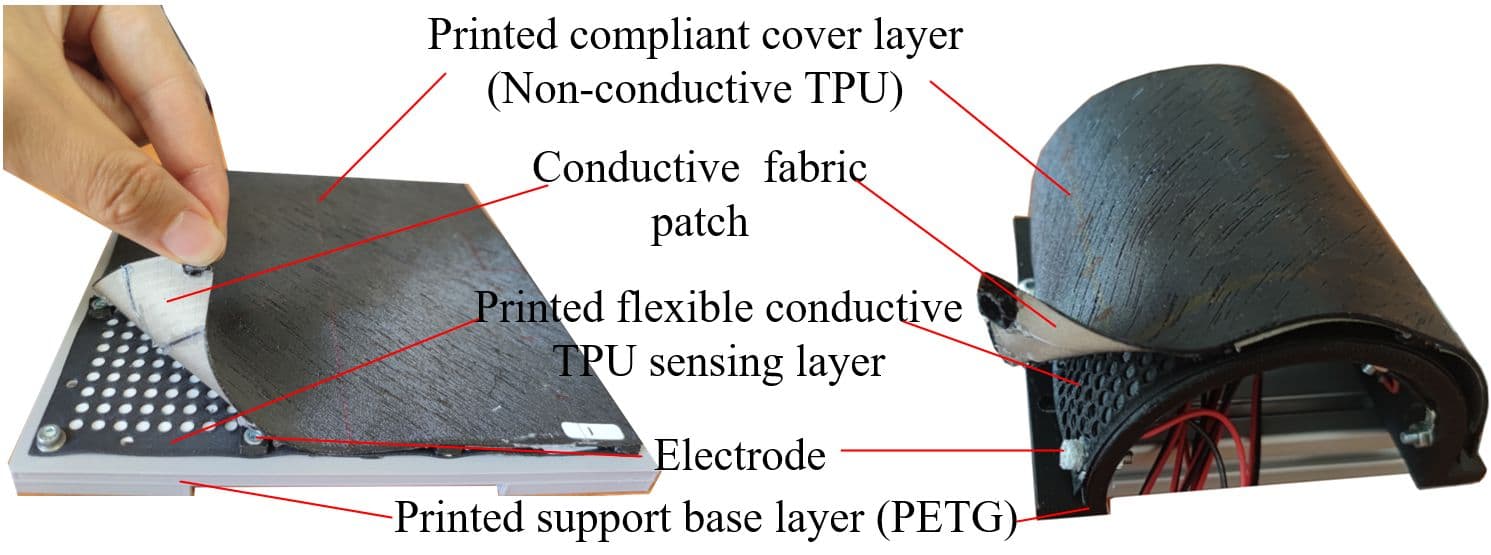
Researchers Haofeng Chen et al. have published a paper on arXiv (2608.02080v1) describing a 3D-printed artificial skin that gives humanoid robots functional touch sensation using electrical impedance tomography (EIT). The system sidesteps the wiring and reliability failures of traditional multi-sensor arrays by treating the skin surface as a single resistive sensing plane, the same basic principle as a resistive touchscreen, scaled to cover a robot body.
The skin is built from a flexible TPU layer embedded with surface electrodes and conductive fabric patches bonded to a top TPU cover. EIT measures electrical resistivity across that surface to reconstruct contact location and pressure as a tomographic image. No dense sensor grid, no rats nest of internal wiring. The fabrication is 3D-printed, which matters for scalability and conforming to complex body geometries.
The paper is worth reading in full because the interesting problem is not whether the skin detects touch but how accurately EIT can reconstruct contact events across a non-flat surface, and what the resolution limits actually are in practice. If the approach holds at humanoid scale, it removes one of the persistent hardware blockers for robots that need to safely interact with people and objects using force feedback.
[READ ORIGINAL →]