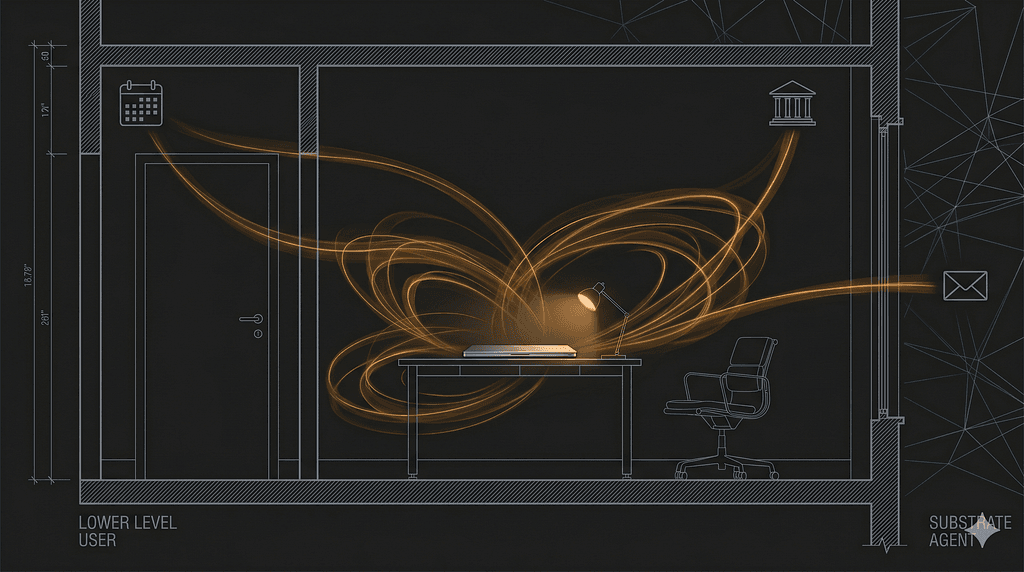
Google I/O 2026 shipped six interlocking products that together form the first consumer-scale agentic stack. Gemini Spark runs on a dedicated Google Cloud VM, 24 hours a day, scanning your finances and calendar while your screen is dark. Antigravity 2.0 orchestrates 93 sub-agents in parallel. Android Halo is a single ambient dot signaling that work is happening on your behalf, right now, somewhere else. Sundar Pichai said it plainly: 'So you don't need to keep your laptop open.' That sentence is not a feature announcement. It is a declaration that the human has moved from operator to principal.
The word choice matters. A user operates. A principal authorizes and is represented. The entire vocabulary of UX, affordance, learnability, mental model, navigation, was built for users who are present. None of it applies to someone who has delegated authority to an autonomous layer. John Maeda called this shift from UX to AX the most profound moment in 11 years of Design in Tech reports, two months before the keynote. Microsoft's Work Trend Index measured 15x agent growth year over year in Microsoft 365, 18x in enterprises. Victor Yocco at ServiceNow put the design problem in one sentence: 'Autonomy is an output of a technical system. Trustworthiness is an output of a design process.' Four researchers, four institutions, no coordination. Same conclusion.
The full article is worth reading for two things the summary cannot carry. First, the six-layer architectural breakdown, device, dev tools, open web, OS, search, and model, shows how each announcement targets a separate substrate and how they interlock into a single coherent delegation stack. Second, the principal-versus-user distinction is developed with enough precision to be practically useful: the article identifies exactly where current design practice fails and names what no existing discipline yet covers. The gap is real, it is now visible at billion-user scale, and this piece is one of the first to name it correctly.
[READ ORIGINAL →]