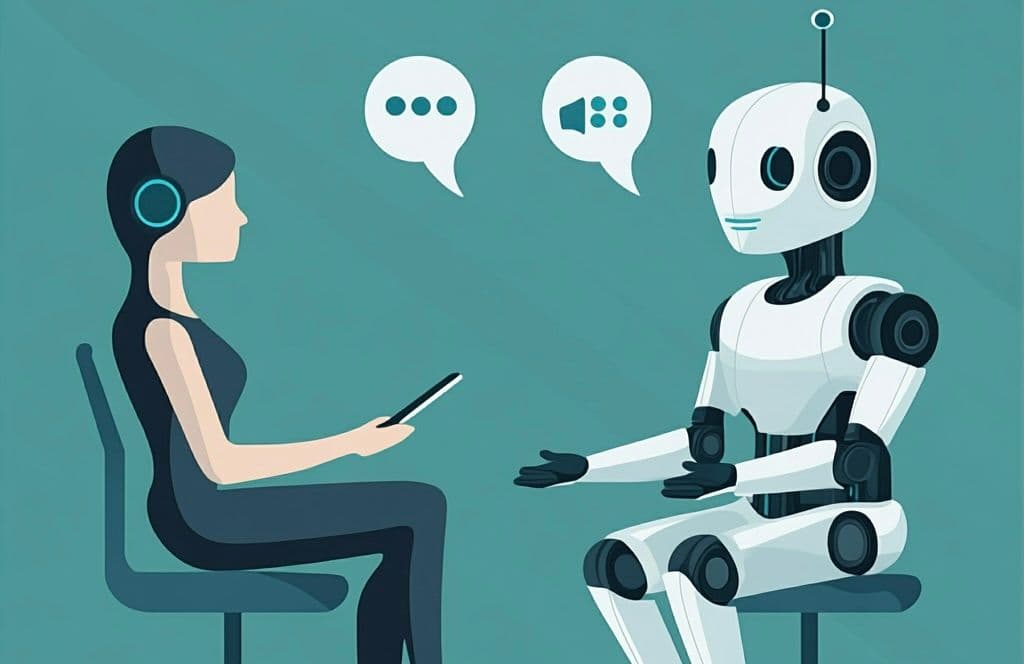
Benchmark scores for LLMs keep climbing. MMLU, HumanEval, MATH: all trending up for models like GPT-4o and Claude 3.5 Sonnet. User experience is not keeping pace. The reason, argued in this piece from The Gradient, is structural: current benchmarks measure one-shot performance, not the multi-round, goal-directed conversations that define real human-AI collaboration. The authors call this gap 'purposeful dialogue,' and its absence explains why capable models still feel clumsy as actual assistants.
The argument gets concrete fast. SWE-bench, which tests AI on real GitHub issues, exposes the limit: no single-pass generation solves a messy engineering problem. The AI needs to ask for missing documentation, clarify requirements, and hand off tasks it cannot complete. The same logic applies to travel planning, therapy bots, and email drafting. The article traces dialogue systems from Roger Schank's 1970s restaurant scripts and ELIZA through RLHF-tuned LLMs, showing exactly where the dialogue format enters the training pipeline, specifically at the fine-tuning stage, not pretraining, which is why models treat conversation structure as a thin veneer rather than a core competency.
The full piece is worth reading for its technical breakdown of how chat formatting, system prompts with tags like INST and system, and RLHF interact, and why that pipeline produces a model optimized for single-turn helpfulness rather than long-horizon goal pursuit. The authors frame human-AI interaction as a collaborative game, drawing on negotiation theory and Terry Winograd's procedural view of language. The open question they leave on the table: what would training actually look like if purposeful dialogue were the objective from the start, not an afterthought bolted on during fine-tuning.
[READ ORIGINAL →]