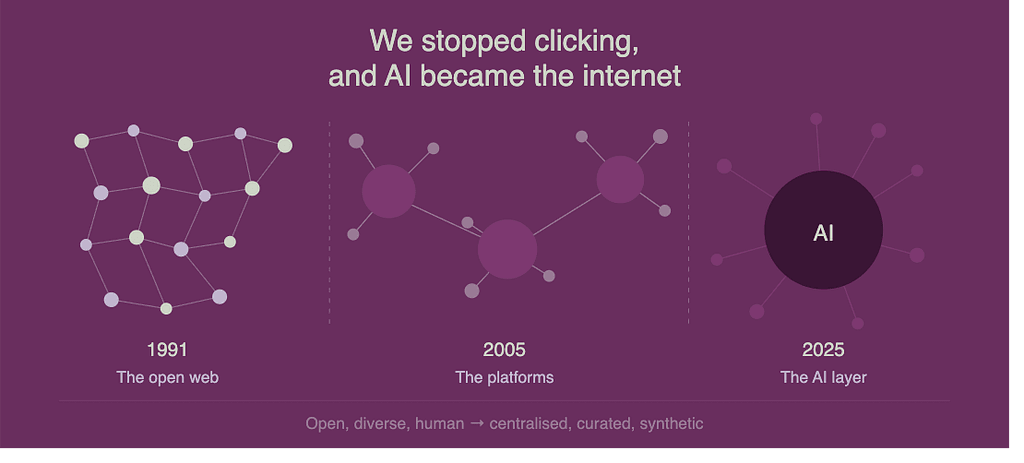
In 2026, over half of all web traffic is generated by bots, not humans, according to HUMAN Security's State of AI Traffic report. AI-driven bot traffic grew roughly eight times faster than human web traffic in 2025. Meanwhile, SparkToro found that more than half of all Google searches now end without a single click to an external site, and Google's AI Overviews suppress clicks to underlying pages by around a third. The handshake between reader and writer is breaking down, quietly, at scale.
The piece traces three compounding failures. First, net neutrality eroded and private platforms replaced open architecture with engagement-optimized algorithms, which Bail et al. (2018) showed hardened political polarization rather than softening it. Second, AI assistants now intercept queries before exploration can begin, compressing the open web into pre-digested summaries from authors users will never encounter. Third, a Graphite analysis of 65,000 articles found that 86 percent of content ranking in Google Search is still human-written, meaning AI is parasitic on a corpus it is simultaneously starving of the clicks that fund its continued production.
The argument the author is building, and has not yet finished making, is not that the internet is dying. It is that displacement is more dangerous than collapse because it is harder to name and harder to reverse. The specific numbers cited, the Bail research, the SparkToro zero-click data, the McKinsey finding that 44 percent of AI search adopters already treat it as their primary information source, are not decoration. They are the architecture of a case worth reading in full.
[READ ORIGINAL →]