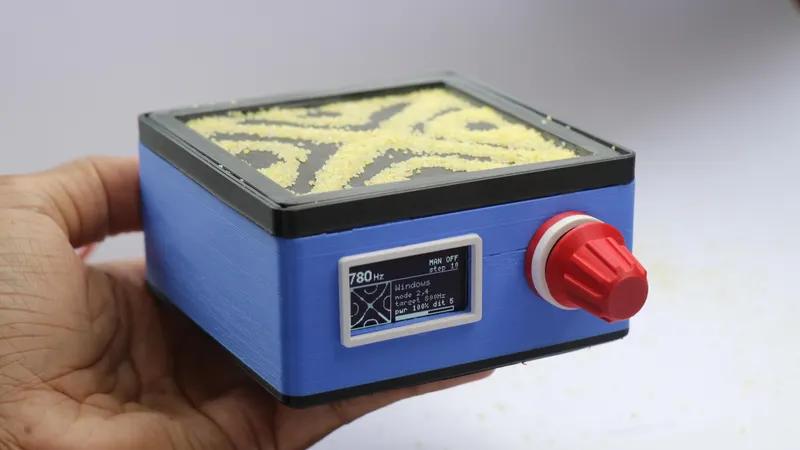
Ernst Chladni invented the resonance visualization plate in 1787 using a metal sheet and a violin bow. CrazyScience rebuilt it with an ESP32, a speaker, salt, a rotary encoder, and a 3D-printed enclosure. The result maps standing wave nodes directly onto a physical surface in real time.
The build lets you dial through discrete frequencies via the rotary encoder while an OLED display tracks the current value. The salt migrates to nodal lines, the points of zero vibration, forming geometric patterns that change as frequency shifts. The mechanism is pure physics: no algorithms, no post-processing.
The original Instructables writeup is worth reading for the frequency selection logic and ESP32 signal generation specifics, not just the assembly steps. If you have ever wondered how pre-CRT engineers visualized wave behavior, this project is a working answer to that question.
[READ ORIGINAL →]