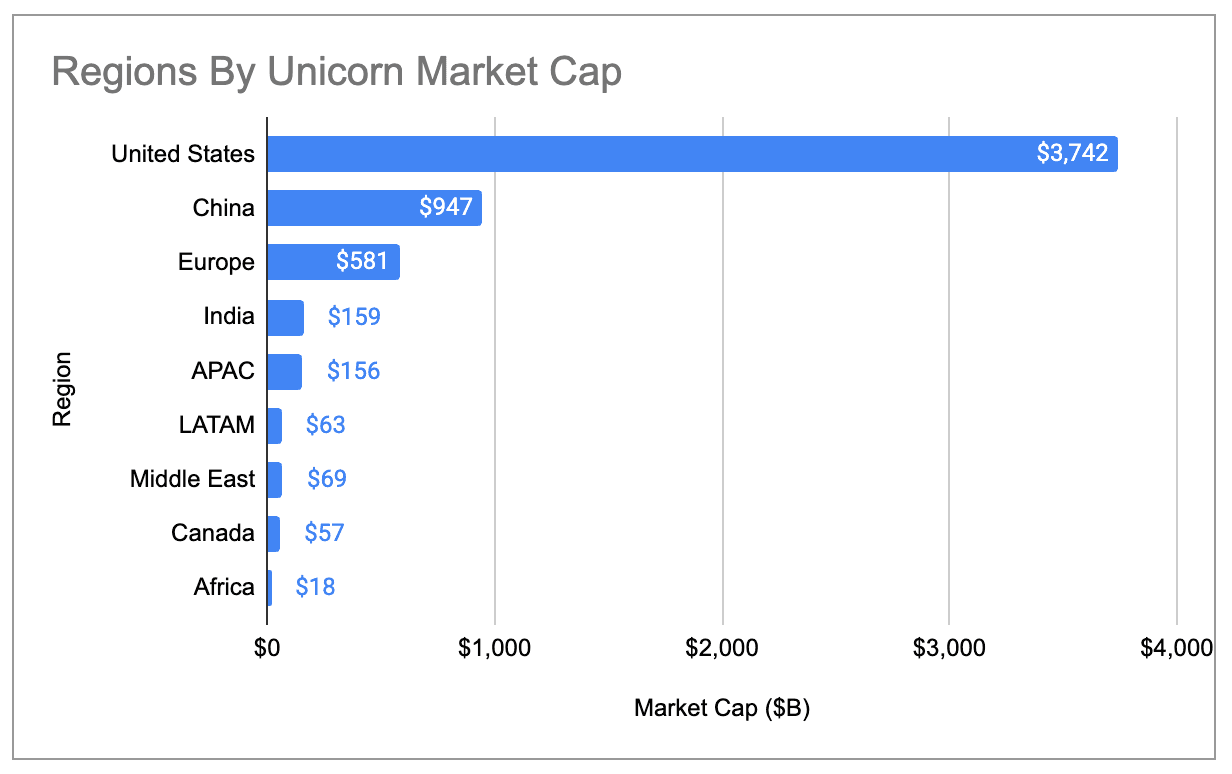
The San Francisco Bay Area now holds 91% of global generative AI private market cap, all within a 1-hour radius. The Bay Area's overall share of global unicorn market cap jumped from 29% to 39% in a single year, more than 4x any other city. The US added $1.2 trillion in unicorn market cap in 2024 alone and now controls 65% of the global total, up from 44% in 2020. Europe has passed China in share, but sits at just 10%.
New unicorn creation has collapsed. Only 300 new unicorns were minted between 2022 and 2025, versus 900 in the three years prior. The count barely grew, up 6% year-over-year, but total market cap rose 33% in the same period. That gap is almost entirely explained by gen AI: the average gen AI unicorn grew its valuation by $2.2 billion year-over-year, compared to $400 million for non-AI companies. Gen AI's share of total unicorn market cap went from 2% to 22% between 2024 and 2026.
The full analysis by Shreyan Jain, pulling CB Insights data as of December 31, 2025, is worth reading for the city-level breakdowns alone. New York's top 10 unicorns are dominated by fintech and crypto. LA's top 5 are led by SpaceX, Anduril, and Relativity, three defense and space companies that account for 83% of LA's total unicorn market cap. The data also shows that companies becoming unicorns in 2023 or later are dramatically more US-concentrated, 83% US share versus 60% for earlier cohorts, which tells you where the next cycle is being built.
[READ ORIGINAL →]