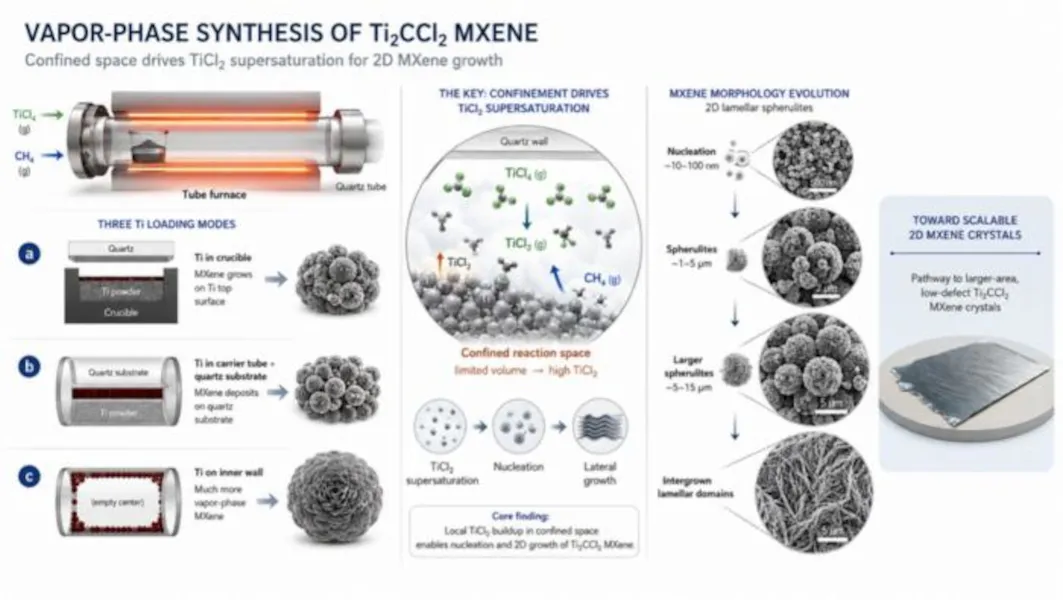
MXenes, the two-dimensional carbide and nitride materials first synthesized over a decade ago, finally have a viable path to industrial-scale production. New research published via EurekaAlert describes a vapor deposition process that eliminates the etching step entirely and removes the need for repeated centrifuge separation, two of the most production-limiting bottlenecks in the original synthesis method.
The old process required combining precursor materials with an etchant, washing, and spinning in a centrifuge multiple times to isolate usable MXene. The new method uses cheaper precursors, skips the etch, and produces material with greater dimensional control and higher purity. That combination of lower cost and better output quality is what separates this from typical incremental lab results.
MXenes have demonstrated real utility across battery electrodes, RF antennas, water filtration membranes, and switchable Faraday cages. None of those applications scaled because the material could not be made cheaply or consistently enough. Read the original to understand exactly where the vapor deposition method intervenes in the synthesis chain and why the researchers believe controllable growth is the key variable that prior methods could never lock down.
[READ ORIGINAL →]