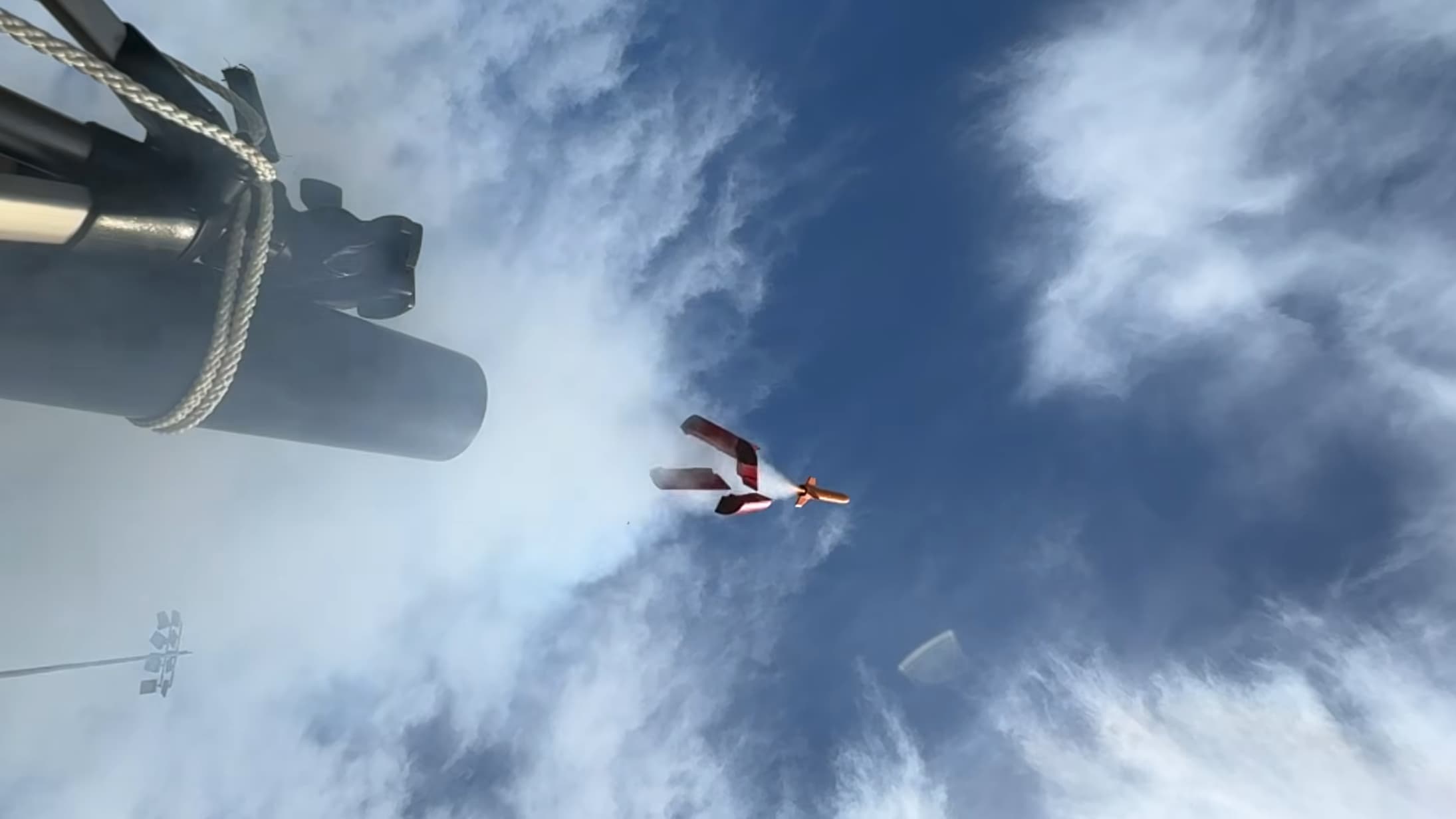
A tube-launched model rocket flew 72% higher than a rail-launched equivalent, according to altimeter data collected by hobbyist Con Hathy. The inspiration was the Arcas sounding rocket, a real-world design that used a gas-fed launch tube to reach 100 km altitude. Hathy wanted to know if the principle scaled down.
It did not work on the first attempt. The initial tube diameter was too wide. As the rocket accelerated down the tube, the volume behind it grew faster than the engine could fill it with exhaust, creating a partial vacuum that actively slowed the rocket. A pressure sensor confirmed this. Hathy rebuilt the system with a narrower tube, a redesigned sabot with foam sealing, and 3D-printed pop-out stabilizer fins that collapsed flush against the body inside the tube and deployed on exit.
The pressure sensor data from the second launch showed the tube was still not long enough to extract maximum performance, meaning the 72% altitude gain is a floor, not a ceiling. The full piece is worth reading for the simulation Hathy built to diagnose the vacuum problem, and for the specific geometry decisions that turned a failed concept into a working one.
[READ ORIGINAL →]