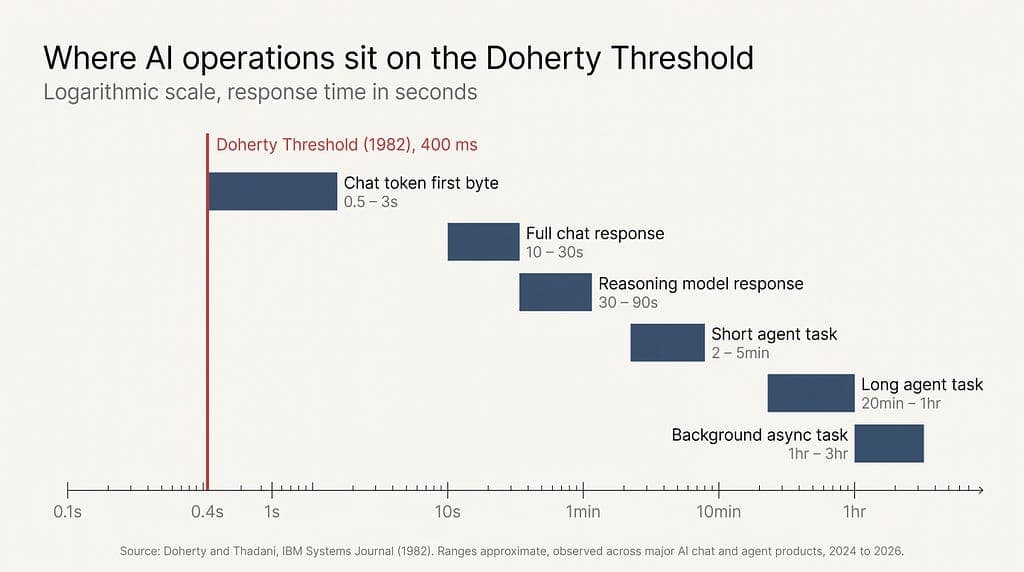
The Doherty Threshold has been a published number since 1982: 400 milliseconds. Below it, users think with a system. Above it, attention leaks. Every major AI product launched in 2023 and 2024 missed it. Agents that shipped in 2025 missed it by minutes.
The evidence is not theoretical. Brad Myers proved in 1985 that progress indicators reduce perceived wait time and increase task completion rates. Jakob Nielsen codified three hard limits: 0.1 seconds feels instant, 1 second preserves flow, 10 seconds loses the user entirely. Don Norman made continuous feedback a first principle of interaction design. AI chat products deliver a pulsing dot and nothing else. Agentic products deliver two states: thinking, and done. The middle, the part where users stay engaged, does not exist.
What makes this piece worth reading in full is not the conclusion but the specifics: a real session recording of a power user who missed a completed answer and typed the same question twice, a taxonomy of user-invented workarounds including the second-tab check and the read-receipt reload, and a direct argument that streaming tokens are the only AI affordance that accidentally satisfies Myers's 1985 criteria. The author discloses a commercial interest in AI UX gaps, which makes the sourcing worth scrutinizing and the argument worth testing against your own usage.
[READ ORIGINAL →]