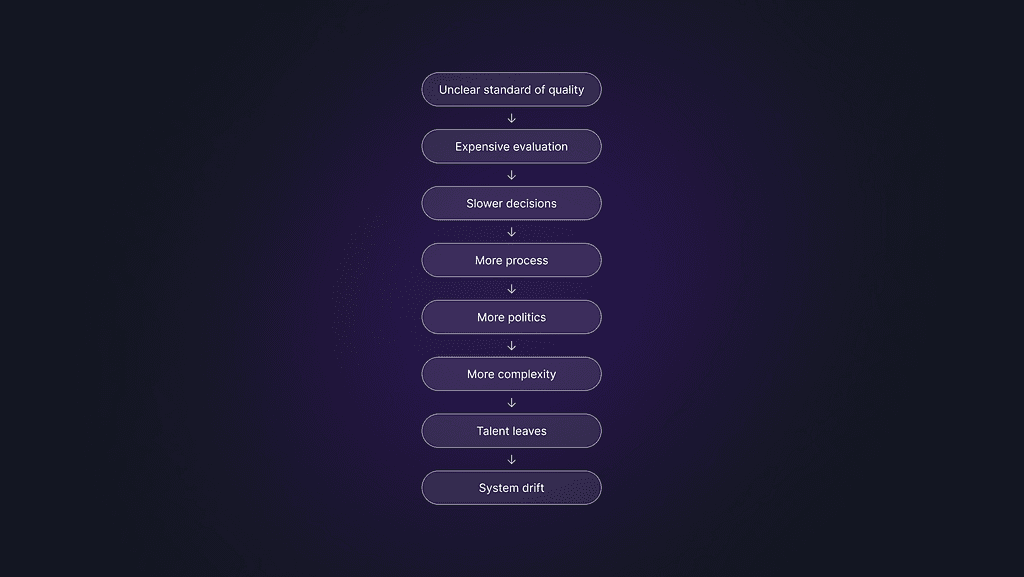
Creation is cheap. Judgment is not. That asymmetry, which first showed up in individual designers overwhelmed by AI-generated output, has a direct organizational equivalent: companies that lose a shared standard of quality do not fail at strategy. They fail at decisions. The symptom chain is consistent across company sizes: a 50-person startup shows the same decision paralysis as a 2,500-person enterprise. Meetings multiply, roadmaps bloat, and the people most sensitive to quality exit first.
The missing variable is taste, defined here not as aesthetic preference but as an operational standard for what deserves to exist. Dieter Rams at Braun is the clearest historical case. His 10 principles functioned as compression, not inspiration. Designers and engineers already agreed on what good looked like, so most options were filtered out before any meeting occurred. Herbert Simon called the underlying mechanism bounded rationality: decision quality improves not by evaluating more options carefully, but by eliminating most options before evaluation begins. When that filter is absent, every decision stays open longer, more stakeholders get pulled in, and the bottleneck shifts from execution to selection.
The piece is worth reading in full because it maps the downstream consequences in sequence: weak taste makes evaluation expensive, expensive evaluation invites process, process invites politics, politics substitutes consensus for clarity, and complexity accumulates because additions are always easier to approve than removals. Each stage feels like a new problem. It is the same problem. The article also raises a forward question it does not fully answer: as AI floods organizations with generated options, the cost of weak taste compounds. That is where this analysis points, and where the harder work begins.
[READ ORIGINAL →]