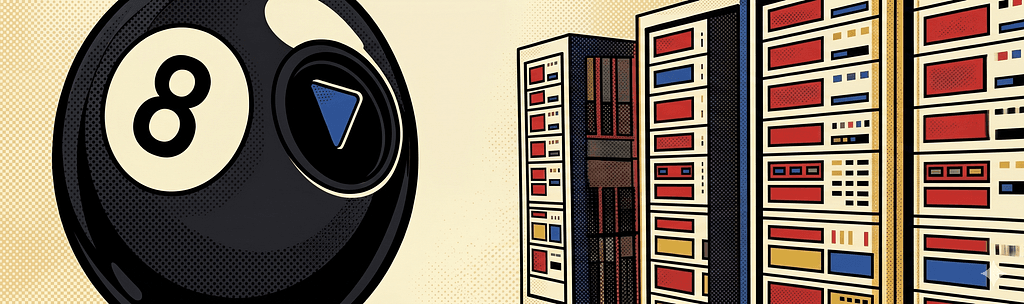
A plastic novelty toy from 1950 and a trillion-dollar compute infrastructure both do the same job: answer questions humans are uncertain about. The Magic 8-Ball cost two dollars, ran on dark blue alcohol and a 20-sided die, and required no subscription. GPT-3 alone consumed an estimated 700,000 liters of freshwater during training, per a 2023 UC Riverside study. Both sample from a distribution. The scale and the marketing are what differ.
The design contracts are opposite, and that gap is where this piece earns its read. The 8-Ball made the randomness visible: you shook it, you watched the die float up, you got 'Reply hazy try again' and knew to try again. Modern AI wraps the same probabilistic mechanism in fluent prose and structured formatting. A 2024 Nature Machine Intelligence study found users systematically overestimate LLM accuracy because confident language reads as warranted confidence. Stanford's RegLab measured hallucination rates between 58 percent for ChatGPT-4 and 88 percent for Llama 2 on verifiable federal court case questions. The 8-Ball never hallucinated. It just said it did not know.
The infrastructure cost comparison is the sharpest argument in the full article, and the design implications for product builders are specific. The 8-Ball built three checkpoints of human judgment into its physical form: question framing, the shake, the wait. Most modern AI interfaces have zero. The article does not conclude that LLMs are bad. It asks what your interface would look like if the cost were visible, and whether maximum polish is a design choice or just a demo habit.
[READ ORIGINAL →]