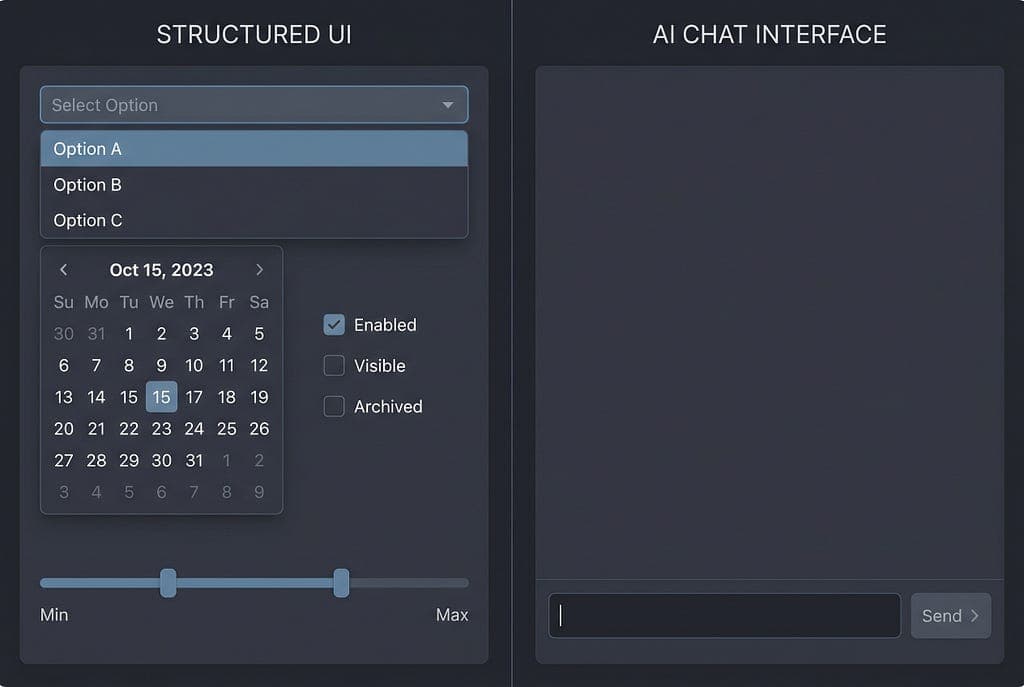
Chat became the default AI interface because text boxes were fast to build in 2022, not because they were good for users. A blank text field gives no affordances, no schema, no feedback on system competence. Don Norman named the failure mode 40 years before LLMs existed: the gulf of execution and the gulf of evaluation. Chat maximizes both simultaneously. Nielsen Norman Group's Accordion Editing research confirmed the cost empirically: users rarely get what they want on the first try, so they iterate through additional prompts. The word 'conversation' is a euphemism for an iteration loop the system forced on them.
The interface chat replaced had four decades of research behind it. Shneiderman's 1983 direct manipulation framework, structured forms, progressive disclosure, undo stacks, contextual menus. AI products abandoned almost all of it. Bret Victor's 2006 essay Magic Ink argued that interaction is the last resort of good information design. Chat inverts this completely: there is no information surface until the user has already interacted with it, in prose. Maggie Appleton, designer at Elicit, put the alternative plainly in her Language Model Sketchbook: most LLM implementations should be 'spell-check sized,' scoped, and embedded. Not a chat window.
The industry spent 2024 quietly admitting this. Seven GUI retrofits across three labs in twelve months. OpenAI launched the GPT Store in January, a tile-based catalog. GPT-4o Voice broke the text-only pattern in May. Anthropic shipped Artifacts in June, a side panel rendering code and documents beside the chat. These are not incremental improvements. They are structural corrections to a default that should not have hardened in the first place. The original article is worth reading in full for its catalog of what those retrofits reveal about the original design failure, and for the Wattenberger, Victor, and Appleton citations that predicted it before it happened.
[READ ORIGINAL →]