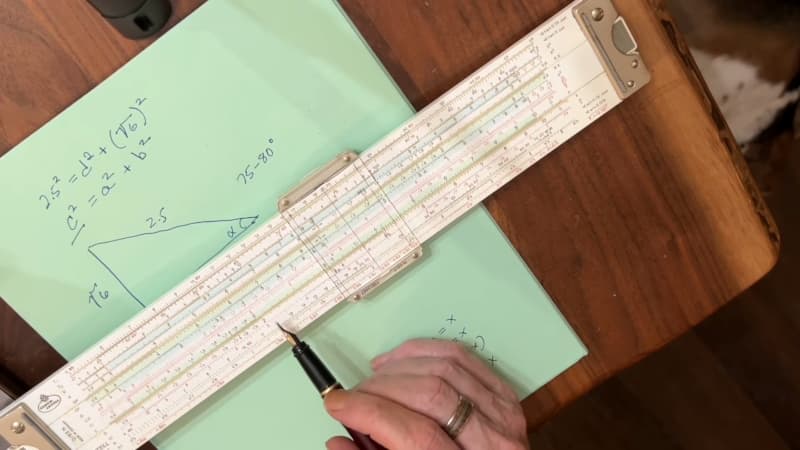
Slide rules cannot add or subtract directly. That limitation is the core problem Bob the Science Guy addresses in his video series on slide rule technique, where he demonstrates how to convert addition-based problems into trigonometric equivalents that the slide rule can actually handle.
The underlying mechanic is physical logarithm addition: sliding two scales together sums their log values, then reads back the antilog as a result. This works cleanly for multiplication and division, but breaks down for addition and subtraction. Bob's method routes around this by reformulating the problem using sine and cosine identities, turning an arithmetic dead end into a solvable trig operation. The catch that never goes away: the rule gives you no information about order of magnitude, so 2 times 3 and 200 times 300 produce identical physical positions on the scale.
The full video is worth watching not for the nostalgia, but for the problem-solving logic. Seeing why trig simplifies a slide rule problem, rather than complicates it, reframes how you think about mathematical reformulation as a practical tool. A browser-based simulator is also available if you want to follow along without hardware.
[READ ORIGINAL →]