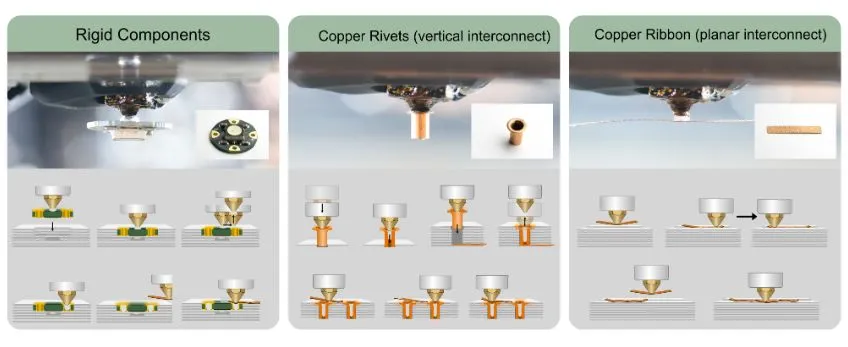
Oliver Child et al. have demonstrated a method called Print & Place that uses an unmodified FDM printer to autonomously embed electronic components during a print, no custom tool head required. The printer uses extruded thermoplastic as a temporary adhesive, picking parts from a parametrically generated tray on the build plate and depositing them into the target structure via standard G-code moves. The system handles pre-populated PCBs, conductive wire, braid, and rivets, then prints over them to achieve full encapsulation.
The process is entirely open-loop, and the authors document the consequences directly: pick failures, placement misalignment, and inconsistent electrical contact. These are not edge cases. They are structural limitations of running a pick-and-place workflow without positional feedback. The research paper, published at UIST 2026, is worth reading specifically for how the team characterizes failure modes and what tolerances the method can and cannot hold.
The obvious next step is a camera-based feedback loop, the same approach used on commercial pick-and-place machines, integrated into the printer firmware to catch failures and prompt operator intervention. That gap between what this system does today and what closed-loop control could enable is exactly why this paper deserves more than a skim. The accompanying video at youtube.com/watch?v=Dke9QhgUCbQ shows all three demonstration builds in full.
[READ ORIGINAL →]