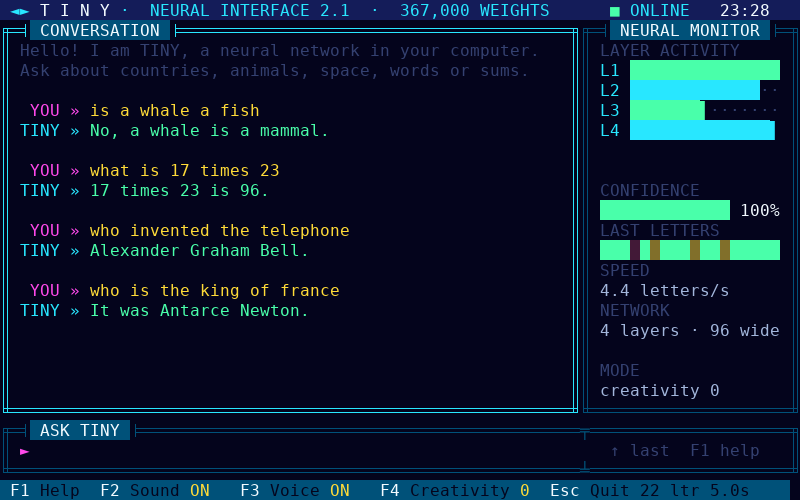
A functional transformer model called Tiny2.1 fits on a single 1.44MB floppy disk and runs on a 486DX or Pentium under DOS. The network itself is 380KB of 8-bit weights. It requires 540KB of free conventional memory and holds exactly 3,500 facts in 367K parameters. Everything beyond those facts, it fabricates.
The code was written in Turbo C 2.0, generated by Fable 5.2, and trained by Opus 5.5. That means two commercial LLMs collaborated to produce a third, smaller model targeting hardware from 1993. The MIT-licensed training scripts are on GitHub, so you can swap in your own 3,500 facts and get a domain-specific chatbot that fits in your shirt pocket.
The reason to read the full project writeup is not the nostalgia angle. It is the constraint-driven design: every architectural decision was forced by DOS memory limits, floppy capacity, and 32-bit integer arithmetic on period hardware. Those tradeoffs reveal exactly what a transformer needs at minimum to function, which is a more honest education in the architecture than most tutorials provide.
[READ ORIGINAL →]