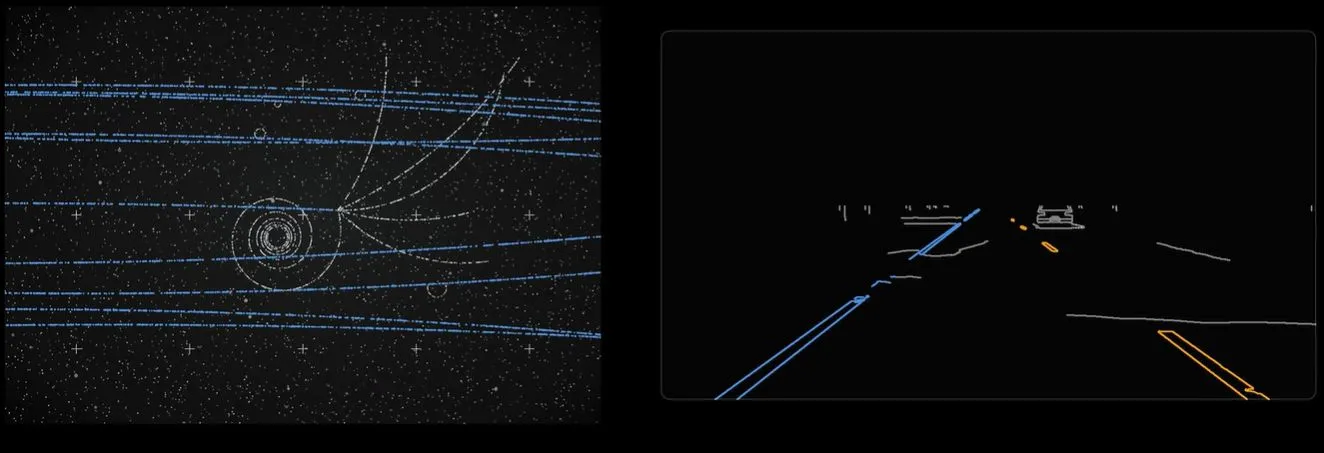
The Hough Transform, invented by Paul Hough in the 1960s to analyze particle tracks in bubble chamber photographs, is a foundational feature extraction algorithm in computer vision. The Synthetic Mind's video breaks down how it detects straight lines by converting image-space edge points into a parameter space where lines appear as intersecting curves, making pattern detection tractable for machines.
The core problem is computational cost. The naive implementation checks every possible line through every edge-detected pixel, which scales catastrophically on real-world scenes. The video walks through why that fails and covers the optimizations, including the Hough accumulator and probabilistic variants, that cut processing time and handle pixel noise. That progression from broken baseline to working solution is the reason to watch the full video, not just read the summary.
Line detection is only the first step. Identifying what those lines represent, assigning meaning to the scene, and triggering an action requires additional sensor layers like radar and LiDAR, particularly in autonomous vehicle systems. The article frames Hough Transforms as an entry point into understanding why computer vision pipelines are so complex, even before any machine learning is involved.
[READ ORIGINAL →]