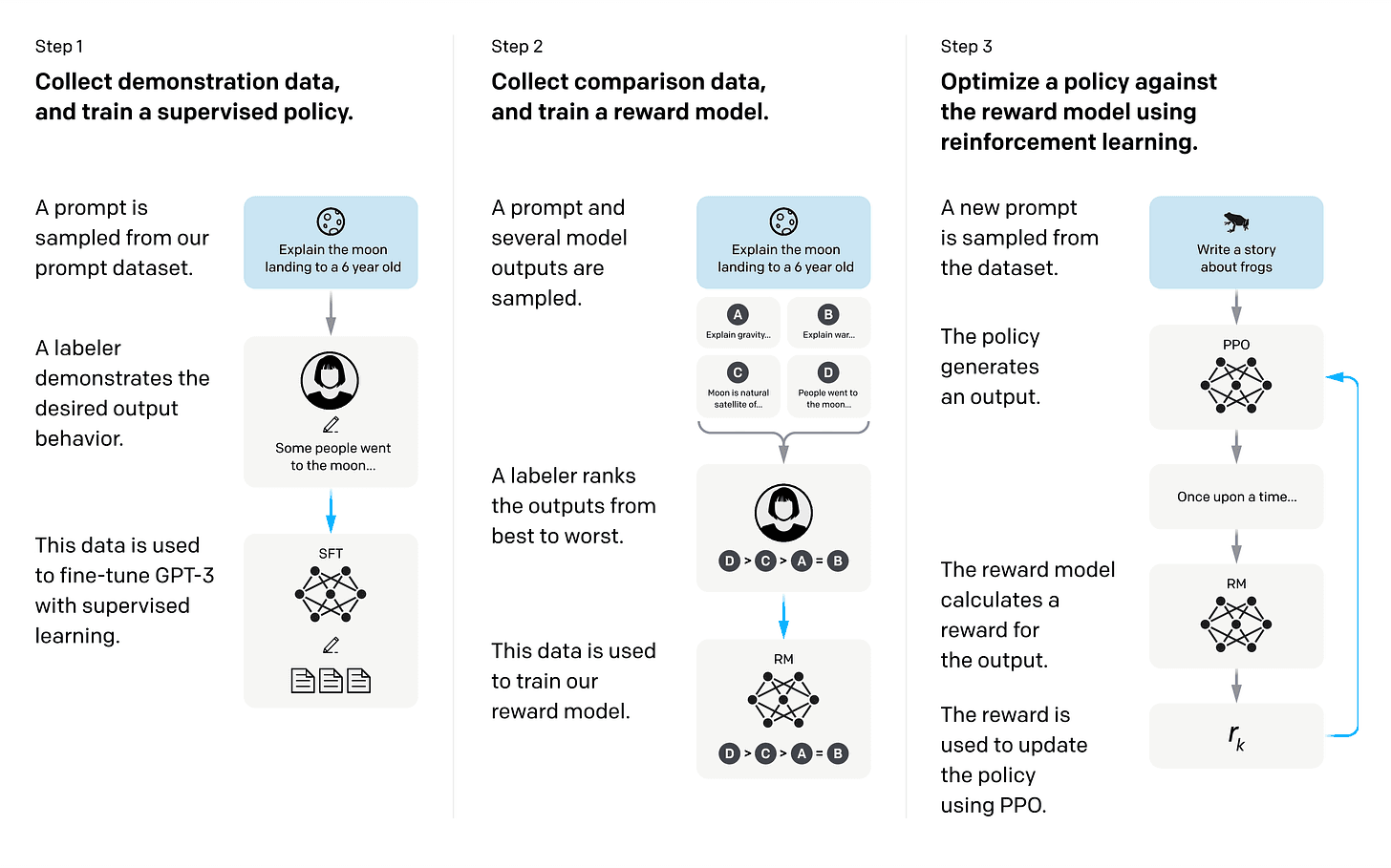
Post-training recipes have changed more in the past year than in the prior three combined. The 2022 InstructGPT pipeline was three steps: SFT, reward model, RL. By 2024, open recipes like Tulu 3 formalized SFT plus DPO plus RL with verifiable rewards. DeepSeek R1 in 2025 made large-scale RL the centerpiece. Now in 2026, MiMo Flash V2 and DeepSeek V4 fragment the entire process into specialist models that are later merged, a technique called Multi-teacher On-Policy Distillation, or MOPD.
MOPD is the pattern worth understanding. You train N domain-specialist teachers, each going through SFT then RL on a single domain. A general student model then samples its own trajectories and minimizes reverse-KL against the relevant teacher's output distribution, token by token. DeepSeek V4 and Nemotron 3 Ultra now scale this to more than 10 teachers. The reason MOPD emerged is concrete: mixing math, code, and agentic RL in one training run causes capability trade-offs. Specialist pipelines are parallelizable, organizationally scalable, and well-understood.
This episode pairs Finbarr Timbers of Ai2 with a full historical slide deck covering InstructGPT through the current frontier, models including GLM 5 and Kimi K2.6. The full podcast runs to chapter marks at 23:00 for 2026 recipes and 48:22 for career advice in the LLM race. The technical notes reference primary sources: DeepSeek V4 section 5.1 and the MiMo-V2-Flash paper on arXiv. The slide deck and the 20-minute walkthrough of it are the reason to watch rather than just read the summary.
[READ ORIGINAL →]