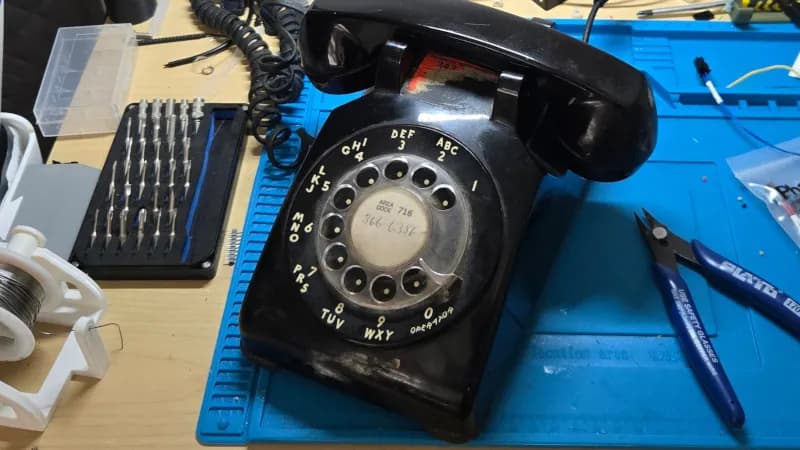
A rotary telephone can now make cellular calls without a single hardware modification to the original unit. Builder fregacmols wired a subscriber-line interface module between the vintage handset and a Lilygo ESP32-S3 board, which handles logic and communicates with a cellular modem. The SLIM does the heavy lifting: it simulates a copper POTS line well enough that the rotary phone never knows it left 1975.
The software accurately reproduces North American subscriber-line behavior, including dial tones and bell ringing on incoming calls. Two undocumented codes are baked in, one opens a wireless network for maintenance access, the other triggers diagnostics. The full schematic and code are public on GitHub under fregacmols/RotaryCell.
Read the original for the wiring breakdown between the SLIM and the ESP32-S3, where the real engineering decisions live. The no-modification constraint is the interesting design choice here: it forced a signal-emulation approach instead of the direct-tap methods used in prior rotary cell conversions, including a 2019 Bluetooth build Hackaday covered separately.
[READ ORIGINAL →]