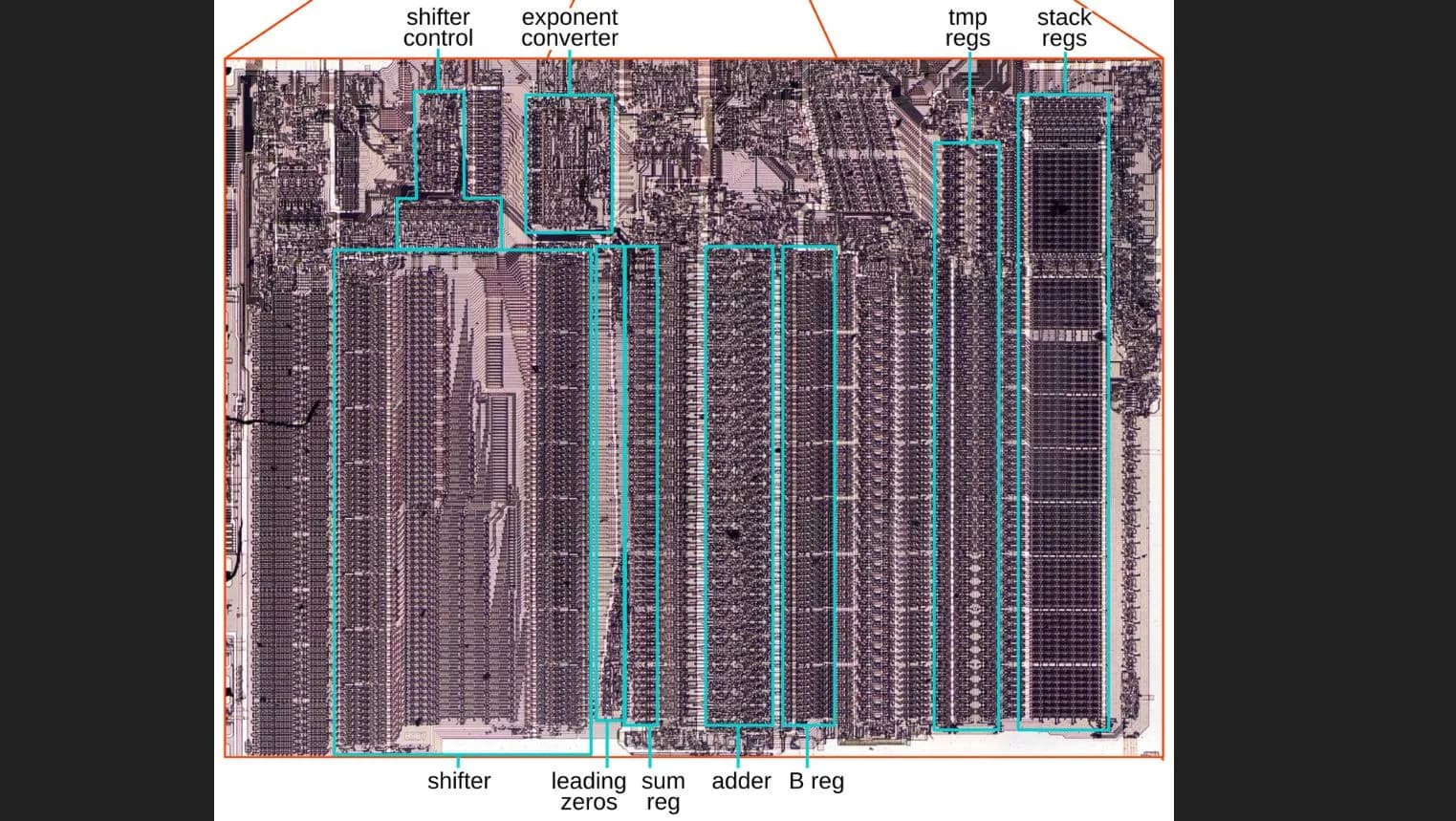
Ken Shirriff reverse-engineered the Intel 8087 die to document exactly how the chip handles floating-point addition and subtraction at the circuit level. The 8087, released in 1980, was the first mainstream x87 floating-point coprocessor, and it delivered roughly 100x speedups over software floating-point on the 8086 for basic operations like adding two numbers.
The core of the analysis is the shifter circuit. Floating-point addition requires aligning exponents by bit-shifting the mantissa, and the 8087 dedicates significant silicon to doing this fast in hardware. Shirriff walks through the actual microcode listing, showing how edge cases like infinities, overflows, and underflows are handled, and why those cases are exactly where dedicated silicon earns its keep over integer-based software emulation.
The full writeup at righto.com includes die photos, circuit diagrams, and annotated microcode. Read it not just for the conclusion but for the step-by-step breakdown of how a seemingly simple arithmetic operation becomes a multi-stage pipeline problem in real silicon, one that still underpins the x87 ISA running on modern x86 hardware today.
[READ ORIGINAL →]