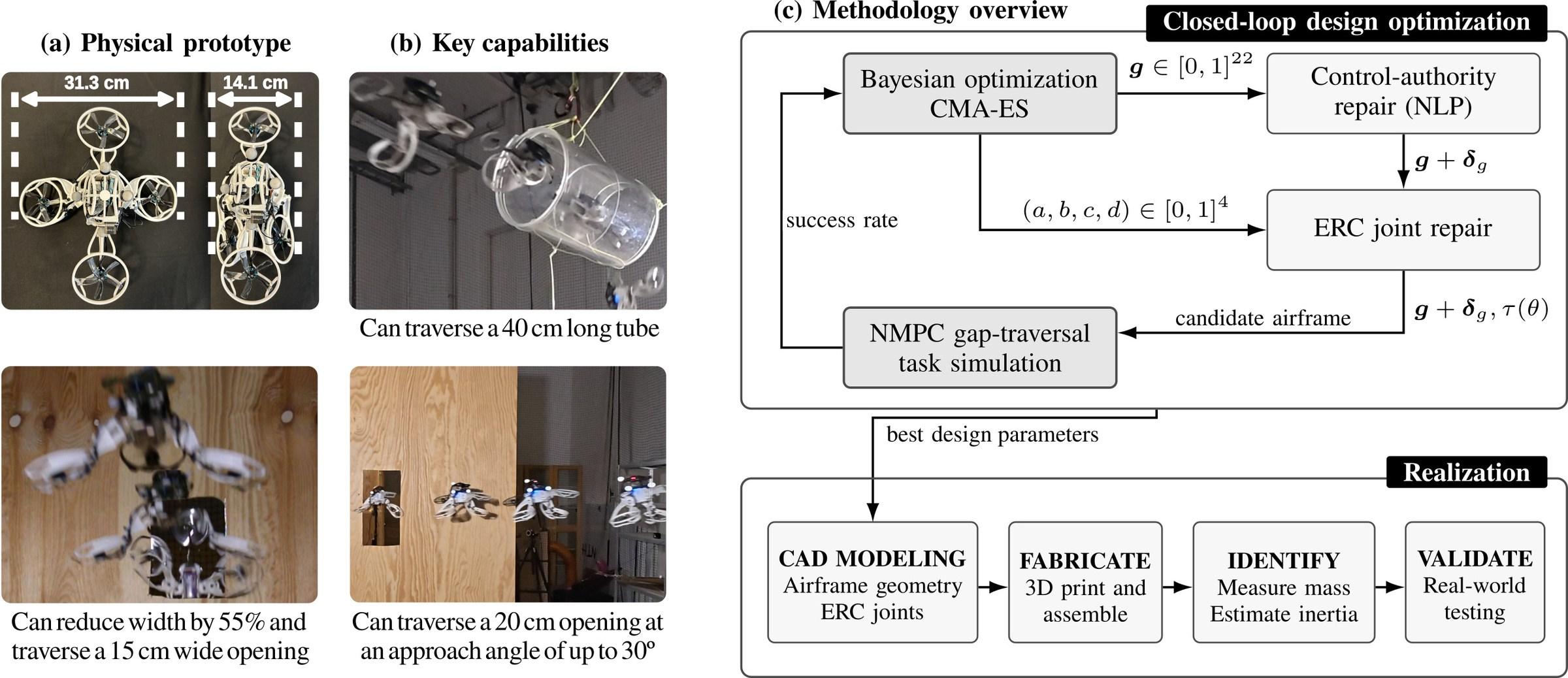
A quadcopter designed by Etor Arza et al. compresses its width from 31.3 cm to 14.1 cm without any active control system, using passive mechanical compliance to squeeze through gaps as small as 15 by 20 cm and tubes 40 cm long.
The key mechanism is elastic rolling cam joints on two of the four arms. No sensors, no actuators, no control loop. The drone deforms on contact, then spring tension in the ERC joints restores the arms to nominal position automatically. The team validated approach angles through simulation before physical testing, and the full design methodology is on arXiv at 2611.09272.
The paper is worth reading for the optimization framework, not just the hardware trick. Passive morphing drones exist, but reliable transformation and self-restoration without active assistance has been the unsolved part. This work addresses that directly, and the approach angle analysis alone has implications for autonomous navigation in constrained environments.
[READ ORIGINAL →]