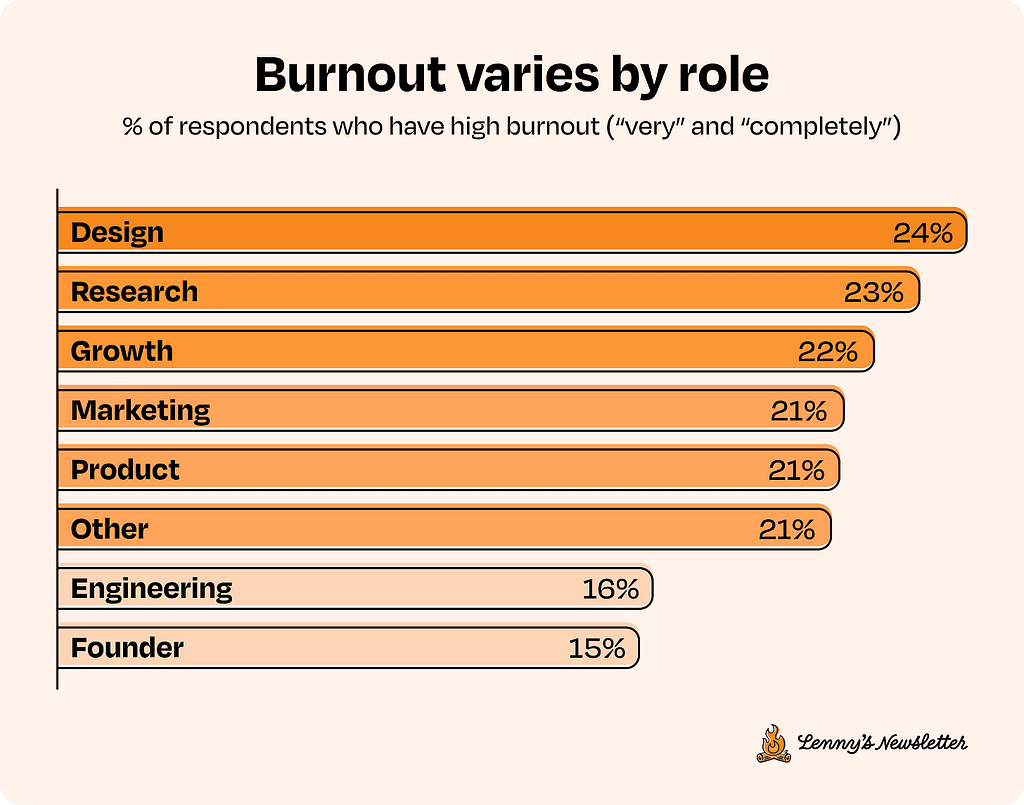
Design and research roles have the highest burnout rates among all tech workers, 24% and 23% respectively, according to a May 2025 Lenny Rachitsky survey of 8,200 people. Higher than engineering. Higher than product. The usual suspects get blamed: AI, layoffs, companies that undervalue design. But the author, a veteran designer, points the finger somewhere more uncomfortable. The career frameworks designers built for themselves, copied from Figma, Intercom, DoorDash, and spread through sites like Progression.fyi, are structurally encoding the problem.
The argument is specific and worth following closely. PM and engineering ladders use behavioral language: actions, outputs, decisions. Design ladders use dispositional language: storytelling, inspiring others, crafting compelling narratives, maintaining an open mindset. That distinction matters because dispositional criteria cannot be disproved. You cannot produce evidence that you maintained an open mindset. Managers can fail designers on perception alone, and because the framework was written with good intentions by respected companies, it carries institutional authority that forecloses pushback. Stuart Frisby is quoted directly: in calibration sessions, design managers are outnumbered by people who work in fundamentally incomparable ways and who don't fully understand what they're measuring.
The field is responding rationally. PM demand is now 1.27x higher than designer demand and growing, per Rachitsky's State of the Product Job Market. Experienced designers are migrating toward roles with clearer accountability and outcomes they can actually track. What the field loses is its most senior practitioners, the people with the most design judgment and the most capacity to resist bad product decisions. The piece is worth reading in full not for the conclusion but for the granular comparison of career ladder language across companies, which makes the structural bias visible in a way that is hard to unsee.
[READ ORIGINAL →]