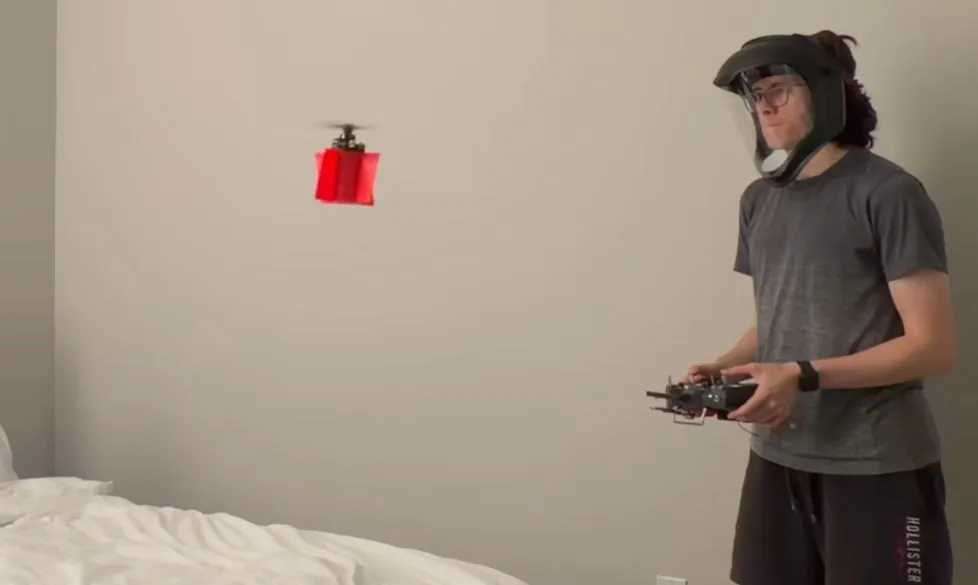
Joshua Bird built a functional single-propeller drone, solving the core problem that kills every similar attempt: attitude control without a second rotor. The key mechanism is a hinged propeller hub that cyclically adjusts blade pitch on every rotation, enabling both pitch and roll control. Standard ESCs failed immediately because they rely on back-EMF estimation rather than direct motor position measurement, making the microsecond-level timing adjustments impossible.
The final prototype required custom motor controller code and direct speed and position sensing to execute real-time blade angle corrections at high RPM. Even that was not enough for stable flight. The drone kept losing positional reference and crashing until Bird added an infrared beacon in the room and a corresponding sensor on the craft, giving it one fixed anchor point to orient against.
Project files are already on GitHub. The next version targets an onboard environment scanner to replace the fixed beacon, which would allow the drone to extract reference points autonomously and potentially fly outdoors. Read the original for the control loop details and the specific failures that forced each design change. The path from concept to hovering prototype is where this gets technically interesting.
[READ ORIGINAL →]