Apollo Global Management chief economist Torsten Slok warned the Washington Post in late July: 'This AI thing better work out because if it doesn't, we're going to have a problem.' This piece quantifies exactly how bad that problem would be. NVIDIA, Google, Amazon, Meta, Microsoft, Broadcom, Micron, AMD, and CoreWeave now represent 46.5% of the NASDAQ 100 and 39.3% of the 3,000-company NASDAQ Composite. NVIDIA alone is 11.31% of the index. The top three, NVIDIA, Google, and Microsoft, carry a combined market cap of $13.5 trillion. At the Dot-Com peak, Cisco, Intel, and Microsoft held 74% of a NASDAQ worth $1.82 trillion. The scale is not comparable.
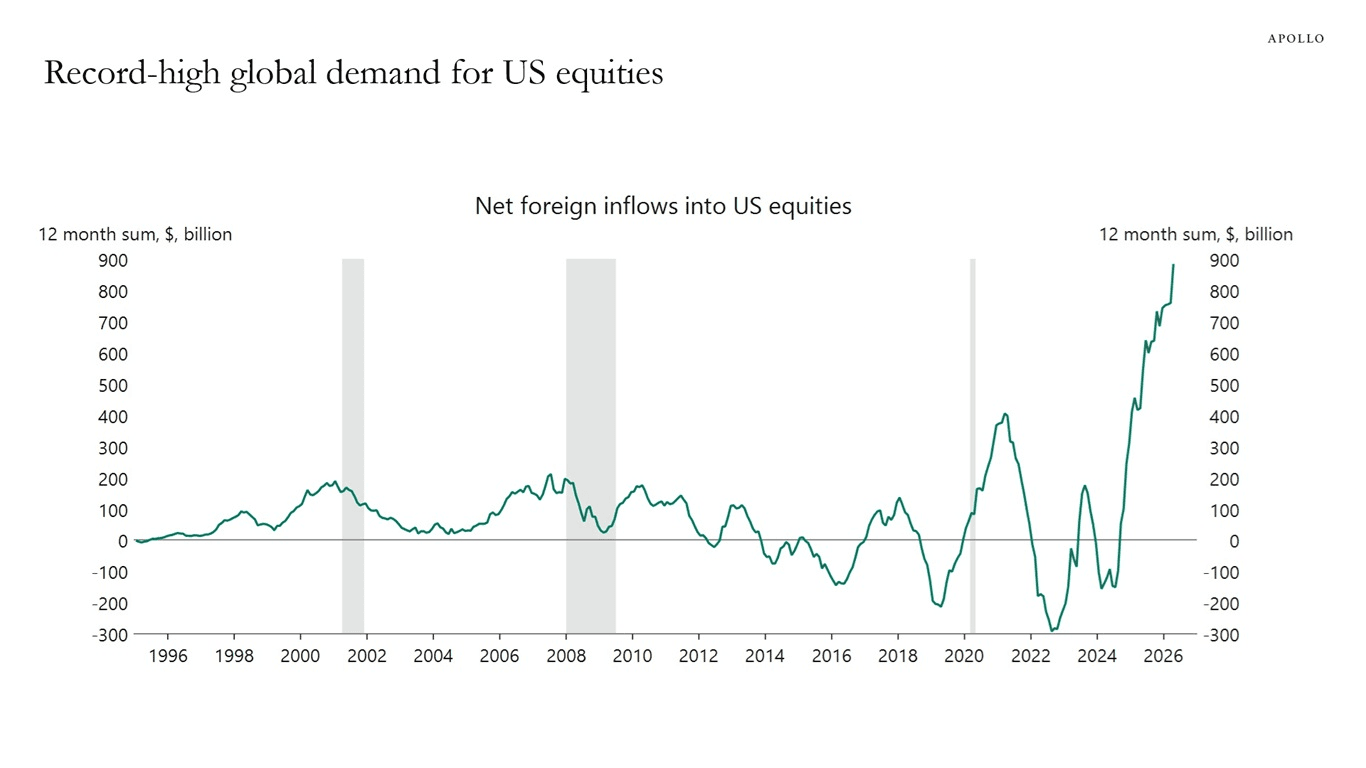
Sustaining these valuations, not growing them, requires every company in this chain to spend or generate hundreds of billions of dollars every quarter, indefinitely. That capital flows from selling AI chips, renting GPU capacity to VC-backed startups, or building software products that have not yet materialized at scale. Foreign inflows into US equities tied to the AI trade are the largest in recorded history, exceeding the Dot-Com bubble, the lead-up to the 2008 financial crisis, and the 2021 zero-interest-rate era. A correction is no longer a domestic equity story. It is a global one.
The full piece goes deeper than the headline numbers. Zitron tracks retail investor exposure, including figures showing retail holds at least 22.4% of NVIDIA and 21.7% of Microsoft's traded stock, against a backdrop where 38% of US household wealth sits in equities. The mechanics of how this unravels, and why the Dot-Com comparison undersells the risk, are what make this worth reading in full. A follow-up piece on Blackstone, described as a firm that has staked its existence on the AI bubble, is next.
[READ ORIGINAL →]