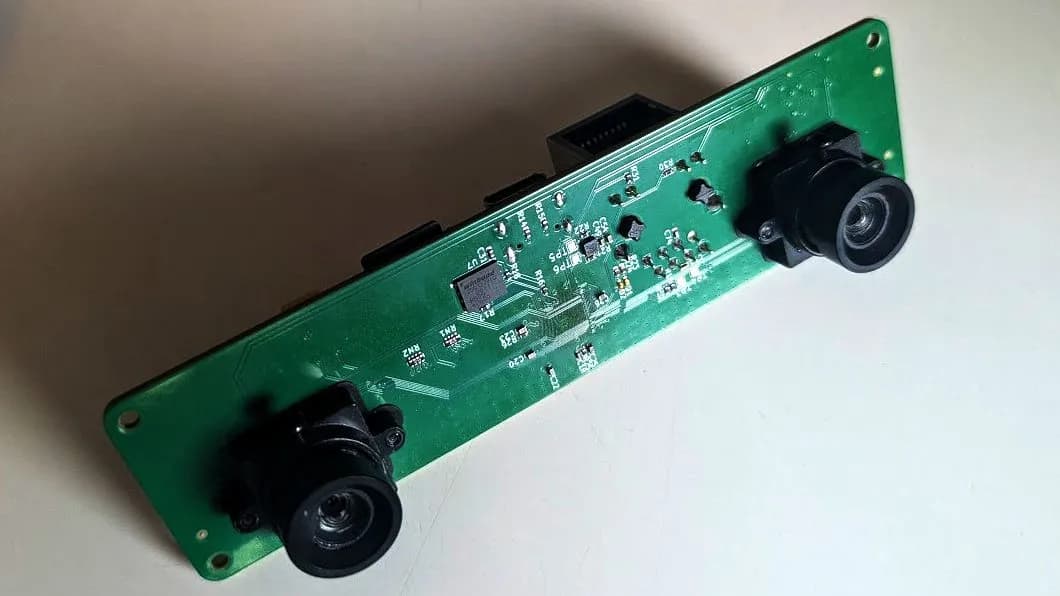
A hardware hacker named machinehum built a compact stereo vision board centered on the Rockchip RV1103, a 1.1 GHz single-core ARM processor with 64 MB of DDR2 RAM and a MIPI CSI-2 bus. The board pairs that chip with two OV9281 global-shutter cameras, a LI2HH12 3-axis accelerometer, 4 MB of onboard flash, and a 10/100 Mbit Ethernet interface. It runs Linux out of the box.
The real substance of the original write-up is in the software layer: machinehum documents the full stack, including how the cameras integrate with Video4Linux2 and how compute, sensing, and networking work together on a single board. That walkthrough is what separates this from a parts list. The design files are public on GitHub.
This board matters because depth perception from stereo cameras is the foundation of serious robotics and spatial computing work, and most accessible platforms force compromises. This one is purpose-built with on-board compute, real sensor fusion, and wired networking. Read the original for the V4L2 integration details and the reasoning behind every component choice.
[READ ORIGINAL →]